About 40 minutes
The horror in the burying-ground — A Closer Reading
Relationships Society Historical Narratives
9,079 recorded words. 27 minutes difference from this book's estimate.
View Gutenberg source #76113
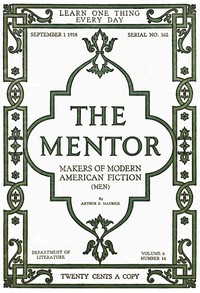
The source record for The Mentor: Makers of American Fiction, Vol. 6, Num. 14, Serial No. 162, September 1, 1918 — Inside the Classic measures this digital text at 15,295 words, 1 hr 7 min estimated reading time, and 17 detected text sections.
The text analysis averages about 19.3 words per sentence, while the detected sections provide another way to judge how the source is divided.
Project Gutenberg metadata also associates the work with “London, Jack, 1876-1916,” connecting these edition facts with the source record’s subject description.
Explore this collection
These alternatives are selected using recorded categories and estimated reading time.
About 40 minutes
Relationships Society Historical Narratives
9,079 recorded words. 27 minutes difference from this book's estimate.
View Gutenberg source #76113About 36 minutes
Relationships Society Historical Narratives
8,244 recorded words. 31 minutes difference from this book's estimate.
View Gutenberg source #67229About 30 minutes
Relationships Society Historical Narratives
6,727 recorded words. 37 minutes difference from this book's estimate.
View Gutenberg source #68553Search stored excerpts and compare books → Choose by your preferences →
Choices use stored catalog measurements. Estimates vary with reading speed. A shared category is a catalog label, not a claim that two books have the same argument or literary quality.
Search reads excerpt text stored with this catalog and links to its associated Gutenberg record. The connection is stored in the site database; this tool does not recheck that every excerpt is word-for-word identical to that external record. Excerpt search does not cover every chapter and does not verify historical publication dates.
Catalog snapshot checked: 2026-09-25. Coverage: 98 public books, 98 available source excerpts.
Read the complete public-domain text at its original source.
Read on Project GutenbergArthur B. Maurice opens this 1918 issue of The Mentor with a pointed challenge to the notion that writing fiction is easy. He compares the naive reader to the skeptic who thinks sculpture is merely knocking off unwanted marble, missing the crucial knowledge of what to remove. This framing sets the stage for profiles of eight American fiction makers, each examined for their particular methods and achievements rather than for biographical summary.
The issue treats its subjects as craftsmen whose finished products—easy to read but hard to write—result from deliberate labor. Maurice’s editorial voice is evaluative and comparative, drawing attention to how each author found a distinctive path to popularity, whether through regional realism, adventure, or social observation.
Maurice devotes his opening paragraphs to dismantling the assumption that good fiction comes naturally. He quotes Charles Lamb’s retort to a boastful amateur: “anyone could write plays as well as Shakespeare—if he had the mind to.” The analogy of sculpture recurs, emphasizing that the writer’s skill lies in knowing what to cut away. This insistence on craft appears throughout the profiles. For instance, Rupert Hughes is praised for a “range of knowledge of even the remote corners of the great city that has been painstakingly acquired” and used with “the sense of selection of the accomplished story-teller.” The phrase “double and re-doubled labor” captures Maurice’s view that polish requires revision.
The profiles themselves demonstrate this principle. Owen Johnson’s early novels “were read by a limited audience, mildly applauded, and then forgotten” until he turned to schoolboy memories and found success with characters like “The Prodigious Hickey” and “Dink Stover.” Maurice presents this shift not as luck but as a discovery of the right material—the sculptor finding the right block of marble.
Maurice does not shy away from the tension between literary merit and commercial success. He notes that Brand Whitlock’s political career as mayor and minister “obscured Brand Whitlock, novelist,” yet insists that Whitlock remains “at heart a man of letters.” The profile of Samuel Hopkins Adams highlights a novel “involving newspaper life and the sinister influence of the tainted money of patent medicine advertisers on the liberty of the press,” suggesting fiction can engage social issues without sacrificing readability.
Several authors are described as having found their footing only after false starts. Owen Johnson’s early works “were read by a limited audience, mildly applauded, and then forgotten” before his schoolboy stories brought national laughter. Edwin Lefevre is introduced with the caveat that “it is no disparagement of Edwin Lefevre as a workman to say” that his reputation rests on a narrow base. Maurice balances admiration for popular success with a critic’s eye for lasting quality.
The issue’s profiles reveal a strong sense of place. Rupert Hughes’s novels are anchored in “modern Gotham: New York in the grip of the latest follies,” while Stewart Edward White’s collaboration with Adams produced “The Mystery” and “The Flying Death, a tale of Montauk Point.” Owen Johnson’s Lawrenceville stories inspired motorists to break their journey “for the purpose of visiting ‘The Jigger Shop,’ where Hungry Smeed established the Great Pancake record.”
Maurice also notes the international dimension: Basil King’s “The Inner Shrine” was published anonymously, with “a dozen different names” suggested before the secret broke. The profile of Brand Whitlock mentions his diplomatic service in Belgium, which “obscured” his fiction. These details suggest that American fiction in 1918 was both rooted in local landscapes and reaching beyond national borders, a tension Maurice captures without overstatement.
Readers approaching this issue should attend to Maurice’s method: he evaluates each author not by abstract standards but by the specific choices that made their work popular or distinctive. The profiles reward attention to the recurring contrast between early failure and later success, and to the way place and craft intertwine. The issue is best read as a series of case studies in how American fiction makers of the early twentieth century solved the problem of the marble block.
Flipping through that old 1918 Mentor, I found myself thinking about how those writers mastered effortless prose, each story a quiet door left ajar. It reminded me of evenings spent with The ghost of Charlotte Cray, and other stories — Reading Companion, where the same gentle craftsmanship lingers, unhurried, as if waiting for the reader to notice the shadows at their own pace.
Create a short personal record of your experience with this book.