About 176 minutes
The Negro in Literature and Art in the United States — Context and Discussion
Relationships Society Historical Narratives
40,260 recorded words. 39 minutes difference from this book's estimate.
View Gutenberg source #35063
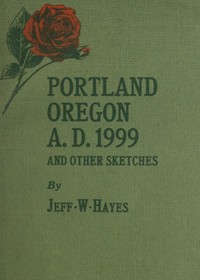
For Portland, Oregon, A.D. 1999, and other sketches — Background and Themes, the stored edition analysis reports 31,331 words, 2 hr 17 min estimated reading time, and 31 detected text sections.
The text analysis averages about 20.7 words per sentence, while the detected sections provide another way to judge how the source is divided.
Project Gutenberg metadata also associates the work with “Short stories, American,” connecting these edition facts with the source record’s subject description.
Explore this collection
These alternatives are selected using recorded categories and estimated reading time.
About 176 minutes
Relationships Society Historical Narratives
40,260 recorded words. 39 minutes difference from this book's estimate.
View Gutenberg source #35063About 67 minutes
Relationships Society Historical Narratives
15,295 recorded words. 70 minutes difference from this book's estimate.
View Gutenberg source #49239About 209 minutes
Relationships Society Historical Narratives
48,041 recorded words. 72 minutes difference from this book's estimate.
View Gutenberg source #68741Search stored excerpts and compare books → Choose by your preferences →
Choices use stored catalog measurements. Estimates vary with reading speed. A shared category is a catalog label, not a claim that two books have the same argument or literary quality.
Search reads excerpt text stored with this catalog and links to its associated Gutenberg record. The connection is stored in the site database; this tool does not recheck that every excerpt is word-for-word identical to that external record. Excerpt search does not cover every chapter and does not verify historical publication dates.
Catalog snapshot checked: 2026-09-25. Coverage: 98 public books, 98 available source excerpts.
Read the complete public-domain text at its original source.
Read on Project GutenbergThe title piece, "Portland, Oregon, A.D. 1999," opens with a "queer little old woman" in Quaker garb who delivers prophecies to a skeptical narrator. Hayes frames these predictions as "the signs of the times," yet the narrative quickly becomes a vehicle for boosterish descriptions of a futuristic Portland—complete with electric railways, grand buildings, and social harmony. The book then pivots sharply to a second section of short sketches drawn from the author's experiences in the late 19th-century West. These tales, such as "The Bad Man From Bodie" and "A Grapevine Telegraph Line," are grounded in specific incidents and named individuals, offering a granular, often comic view of frontier life. The juxtaposition of a utopian future with rough-and-tumble past creates a distinctive tension between aspiration and memory.
Hayes's futuristic Portland is less a work of speculative fiction than an extended civic advertisement. The prophecies, delivered by the mysterious visitor, focus on material progress: the city's population soars, its streets are lined with electric lights, and its industries flourish. Yet the narrative remains tethered to 1913 realities—the visitor mentions specific local landmarks and businesses, grounding the future in the present. The author's preface admits that "not one-half of the story is told," suggesting a deliberate incompleteness. The tone is earnest, but the prophecies lack narrative tension; they function as a wish list rather than a story. This section's value lies in its reflection of early 20th-century American optimism and the specific ambitions of Portland's boosters.
The sketches in Part II are the book's strength. Hayes recounts episodes like Tony Neppach's elaborate lease joke, which coerces a saloonkeeper into selling Weinhard's beer, resulting in an unexpected reward from the brewer himself. The humor is dry and situational, relying on precise details—the lease's preamble praising "Celebrated Weinhard's lager beer"—and the absurdity of bureaucratic overreach. Another sketch, "A Grapevine Telegraph Line," describes a Fourth of July in 1876 when a broken wire disrupts service, highlighting the fragility of early communication networks. These stories are populated with real people (Neppach, Weinhard) and specific places (Slabtown, Alton), giving them a documentary quality. Hayes's voice is that of a raconteur, not a historian; he prioritizes the punchline over analysis.
The book's two parts employ markedly different registers. The utopian section uses elevated, quasi-poetic language—"a low sweet prelude finds its way"—and a framing device that distances the reader from the content. The sketches, by contrast, are colloquial and direct, full of dialogue and concrete action. This structural divide suggests Hayes was unsure whether to write a novel or a memoir. The result is a hybrid work that never fully commits to either mode. Readers should approach the book as a period artifact: the prophecies reveal early 20th-century civic ideals, while the sketches preserve the texture of daily life in the Old West. Neither section is complete in itself, but together they offer a curious double portrait of a city and its chronicler.
Hayes's collection rewards readers interested in local history, the literature of boosterism, or the tall-tale tradition of the American West. The sketches, in particular, benefit from being read aloud, as their rhythms and punchlines are those of oral storytelling. The utopian section may feel dated, but its earnestness is instructive. Approach the book as a time capsule: its prophecies are quaint, its anecdotes vivid, and its author a genial guide to a vanished world.
There’s something poignant in that old Portland book’s optimism about 1999, a future that now feels as distant as its frontier sketches. It makes me think of how we used to imagine progress, and how art captures those hopes differently. That same wistfulness came back to me reading The Negro in Literature and Art in the United States — Context and Discussion, another voice measuring promise against what was.
Your answers remain private and are stored only in this browser.