About 726 minutes
The Decameron, Volume II — Story, Setting & Ideas
Relationships Society Historical Narratives
166,911 recorded words. 60 minutes difference from this book's estimate.
View Gutenberg source #13102
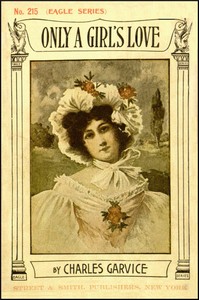
The source record for Only a girl's love — A Closer Reading measures this digital text at 153,084 words, 11 hr 6 min estimated reading time, and 15 detected text sections.
The text analysis averages about 13.1 words per sentence, while the detected sections provide another way to judge how the source is divided.
Project Gutenberg metadata also associates the work with “English fiction,” connecting these edition facts with the source record’s subject description.
Explore this collection
These alternatives are selected using recorded categories and estimated reading time.
About 726 minutes
Relationships Society Historical Narratives
166,911 recorded words. 60 minutes difference from this book's estimate.
View Gutenberg source #13102About 930 minutes
Relationships Society Historical Narratives
213,681 recorded words. 264 minutes difference from this book's estimate.
View Gutenberg source #2853About 347 minutes
Relationships Society Historical Narratives
79,678 recorded words. 319 minutes difference from this book's estimate.
View Gutenberg source #76442Search stored excerpts and compare books → Choose by your preferences →
Choices use stored catalog measurements. Estimates vary with reading speed. A shared category is a catalog label, not a claim that two books have the same argument or literary quality.
Search reads excerpt text stored with this catalog and links to its associated Gutenberg record. The connection is stored in the site database; this tool does not recheck that every excerpt is word-for-word identical to that external record. Excerpt search does not cover every chapter and does not verify historical publication dates.
Catalog snapshot checked: 2026-09-25. Coverage: 98 public books, 98 available source excerpts.
Read the complete public-domain text at its original source.
Read on Project GutenbergFrom its opening pages, Charles Garvice's Only a Girl's Love establishes a world of constrained gestures and watchful silences. In the excerpt, Stella bends to kiss her cousin Frank's forehead; he flinches and says, "I am not worthy." The moment is interrupted by the entrance of Jasper Adelstone, whose "small eyes" fix on the pair. The scene is built on small, loaded actions—a hand held too long, a book of Italian songs offered as a pretext, a boy's "ill-concealed shyness." Garvice's prose lingers on physical details: a hand that is "hot and dry," a voice that is "cautious." These are not merely decorative; they signal the undercurrents of possession, deference, and unease that run through the narrative.
The excerpt repeatedly uses physical contact to define relationships. Stella's kiss is an act of tenderness, but Frank's recoil and his words "I am not worthy" invert the expected power dynamic: the boy, not the girl, assumes a posture of unworthiness. When Jasper arrives, he immediately asserts control. He takes Stella's hand, notes its temperature, and then holds Frank's hand with a "strange smile." The handshake becomes a moment of assessment. Later, Jasper brings music as a gift, but frames it as being for Stella's uncle, a polite fiction that masks his real interest. Garvice builds tension through these small, choreographed interactions: who touches whom, who hesitates, who looks away.
Dialogue in this scene rarely says what it means. Jasper claims to have business with Stella's uncle, but his explanation is full of hesitations: "The fact is," he says, and "I am afraid I shall be rather a frequent visitor." The narrator notes that he "could have cursed himself for his hesitation and awkwardness—he who was never awkward or irresolute at other times." This self-awareness marks Jasper as a man accustomed to control, now unsettled. Stella, for her part, responds with light, noncommittal phrases: "Yes?" and "Indeed, you shall!" Her work—she takes up her sewing—becomes a shield. The characters speak around their desires, and Garvice lets the reader hear the gaps.
Throughout the excerpt, eyes are described with unusual precision. Jasper's "small eyes" are fixed on Stella, then turn to Frank with "a strange look." When Stella and Frank are alone, Jasper appears at the window, "standing with his face turned toward them, with his eyes fixed on them." The word "fixed" recurs, suggesting a gaze that is not casual but predatory. Stella, in turn, is "quite unconscious of the admiration with which the two pair of eyes were fixed on her." Garvice creates a triangle of watching: the reader watches the characters, but the characters are also watching each other, and the narrator watches them all. This layering of glances turns the domestic setting into a stage for unspoken competition.
Readers attentive to body language and oblique dialogue will find Garvice's method rewarding. The novel's tension does not reside in dramatic events but in the space between what is said and what is withheld. Pay particular attention to who initiates touch, who averts their gaze, and who claims the right to interpret a silence. These patterns, visible even in a single scene, suggest a story driven by the struggle for emotional territory.
Stella's guarded glances in that old Garvice novel always reminded me of the secrets we keep within arm's reach. Years later, I found that same tension waiting in The Murder on the Links — Reading Notes, where a single kiss’s shadow stretches far beyond a drawing room, asking us how well we truly know the hearts beside us.
Your answers remain private and are stored only in this browser.