About 338 minutes
Tom Tufton's Travels — Inside the Classic
Relationships Society Historical Narratives
77,632 recorded words. 9 minutes difference from this book's estimate.
View Gutenberg source #13404
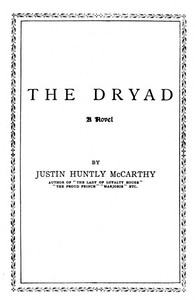
For The dryad — Reading Companion, the stored edition analysis reports 79,678 words, 5 hr 47 min estimated reading time, and 31 detected text sections.
The text analysis averages about 24.2 words per sentence, while the detected sections provide another way to judge how the source is divided.
Project Gutenberg metadata also associates the work with “Historical fiction,” connecting these edition facts with the source record’s subject description.
Explore this collection
These alternatives are selected using recorded categories and estimated reading time.
About 338 minutes
Relationships Society Historical Narratives
77,632 recorded words. 9 minutes difference from this book's estimate.
View Gutenberg source #13404About 336 minutes
Relationships Society Historical Narratives
77,124 recorded words. 11 minutes difference from this book's estimate.
View Gutenberg source #69779About 328 minutes
Relationships Society Historical Narratives
75,290 recorded words. 19 minutes difference from this book's estimate.
View Gutenberg source #44083Search stored excerpts and compare books → Choose by your preferences →
Choices use stored catalog measurements. Estimates vary with reading speed. A shared category is a catalog label, not a claim that two books have the same argument or literary quality.
Search reads excerpt text stored with this catalog and links to its associated Gutenberg record. The connection is stored in the site database; this tool does not recheck that every excerpt is word-for-word identical to that external record. Excerpt search does not cover every chapter and does not verify historical publication dates.
Catalog snapshot checked: 2026-09-25. Coverage: 98 public books, 98 available source excerpts.
Read the complete public-domain text at its original source.
Read on Project GutenbergThe novel opens with Simon of Rouen trampling the grass of the Eleusinian wood, a soldier of fortune whose light heart and rusty iron lantern set the tone for a story that moves between the mundane and the mythical. McCarthy establishes a voice that is both wry and vivid, as Simon whistles his own clumsy rhyme—'When I was no more than a span, Honey and gingerbread pleased me highly'—and carries himself with a swagger that belies his tattered garments. The wood itself is sown with 'splendid memories' of Greek gods and heroes, but Simon cares nothing for them, grounding the narrative in a practical, even cynical, perspective that contrasts sharply with the romantic entanglements to come.
Simon's rusty iron lantern, hanging from his girdle, is more than a prop; it becomes a recurring emblem of his character and the story's method of illumination. Early on, he brandishes a massive oaken cudgel and carries a lantern that seems incongruous in daylight, hinting at a need to see or be seen in a world of hidden motives. Later, in the tournament chapter, the lantern reappears as part of a pattern of disguise and revelation. The captains—Fox, Gander, Bat, Chanticleer, Rat, and Badger—each adopt a costume: a mendicant friar, a wandering minstrel, a lame beggar, a fortune-teller, and mountebanks. Their disguises are both practical and theatrical, allowing them to move through the crowd as 'honest folk' and 'rogues' simultaneously. Simon's own lantern, never lit, suggests a similar duality: a tool that could reveal but remains dark, much like the characters who hide their true intentions behind assumed roles.
McCarthy uses heraldic descriptions not merely as decoration but as a structural device to map the social and political landscape. In the tournament scene, Captain Fox recites a litany of coats of arms: the black pale on silver for the Prince of Epirus, the red bend with laurel wreaths for Andronicus Palæologus, the six gold lozenges on purple for Sir Jaufre de Brabant. Each blazon is a compressed biography, signaling ambition, lineage, or allegiance. The only shield that baffles Fox bears a golden acorn on a green field—a symbol that remains mysterious even to the knowledgeable. This moment underscores how identity in the novel is often a matter of interpretation, with signs that can be read or misread. Prince Rainouart carries a golden shield with no charge, a blank slate that invites projection. The heraldic language thus becomes a code for the reader to parse, linking character to symbol in a world where appearances are deliberately crafted.
The narrative structure depends on a series of shifts between the Eleusinian wood and the courtly spaces of Athens and the tournament. The opening chapter, 'In the Wonder-Wood,' establishes the forest as a place of freedom and memory, where Simon tramples grass that is 'sown with splendid memories' of Greek gods. Yet the wood is also a site of encounter: Rainouart and Argathona meet there, their dialogue marked by a tension between pride and doubt. Argathona, reading 'the lessons of the world's law,' hopes to 'overthrow the guile of a woman with the guile of a girl,' a line that hints at the strategic thinking that governs courtly behavior. The tournament chapter, by contrast, is a set piece of organized spectacle, where the captains' disguises and the heraldic displays create a controlled environment. The movement from wood to court is not simply geographical; it represents a shift from the mythic past to a medieval present, from individual impulse to social performance.
Music and song thread through the novel as markers of character and mood. Simon's own composition—a tripping tune about honey and gingerbread—is described as his 'first adventure in the lyrical,' and he would 'give any man his fist in the face who dared to call him poetical.' This self-deprecating attitude toward art contrasts with the more formal songs that appear in chapter titles like 'The Song of the Forest' and 'The Wine of Esclaramonde.' The forest itself is imagined as a place where 'Wonder-Wood is all aglow / With godlike forms,' as the dedication verse puts it, and where 'the bland Athenian breezes blow.' Rainouart's voice, when he speaks of his love, rings 'clear and bright as a battle-call,' but then ends 'more heavily.' These sonic details—whistling, singing, the shift in tone—create an auditory landscape that complements the visual one. The recurring motif of song suggests that the characters are constantly performing, whether in earnest or in irony, and that the novel itself is a kind of ballad, with refrains that echo across chapters.
Readers attentive to the interplay of surface and depth will find McCarthy's novel rewards a careful eye for its recurring objects—lanterns, shields, disguises—and the way they accumulate meaning across scenes. The narrative does not resolve into simple allegory; instead, it invites the reader to watch how a soldier's lantern, a blank shield, or a captain's costume can shift from prop to symbol. Approach the text as a series of tableaux, each with its own heraldic code, and the wood may reveal more than its 'splendid memories.'
There’s something about that eleusinian wood—the lanterns, the disguises, the way Simon keeps slipping between worlds—that stayed with me long after the last page. It reminded me of how Ancient Rome in the English novel: a study in English historical fiction — A Reader’s Guide lingers in the quiet way it traces old truths through new masks, without ever forcing the point. Ancient Rome in the English novel: a study in English historical fiction — A Reader’s Guide feels like that same gentle ache, really.
Build a private reading journal entry for this title.