About 82 minutes
The Creatures That Time Forgot — Background and Themes
Technology Airships Imagined Futures
18,773 recorded words. 35 minutes difference from this book's estimate.
View Gutenberg source #63874
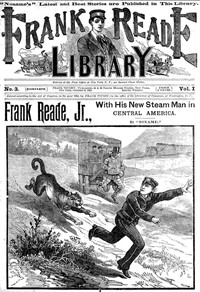
Frank Reade, Jr., With His New Steam Man in Central America — Reading Companion can be approached with a clearer sense of reading commitment from its source measurements: 26,734 words, 1 hr 57 min estimated reading time, and 14 detected text sections.
The text analysis averages about 11.8 words per sentence, while the detected sections provide another way to judge how the source is divided.
Project Gutenberg metadata also associates the work with “Science fiction,” connecting these edition facts with the source record’s subject description.
Explore this collection
These alternatives are selected using recorded categories and estimated reading time.
About 82 minutes
Technology Airships Imagined Futures
18,773 recorded words. 35 minutes difference from this book's estimate.
View Gutenberg source #63874About 73 minutes
Technology Airships Imagined Futures
16,760 recorded words. 44 minutes difference from this book's estimate.
View Gutenberg source #64673About 64 minutes
Technology Airships Imagined Futures
14,643 recorded words. 53 minutes difference from this book's estimate.
View Gutenberg source #70562Search stored excerpts and compare books → Choose by your preferences →
Choices use stored catalog measurements. Estimates vary with reading speed. A shared category is a catalog label, not a claim that two books have the same argument or literary quality.
Search reads excerpt text stored with this catalog and links to its associated Gutenberg record. The connection is stored in the site database; this tool does not recheck that every excerpt is word-for-word identical to that external record. Excerpt search does not cover every chapter and does not verify historical publication dates.
Catalog snapshot checked: 2026-09-25. Coverage: 98 public books, 98 available source excerpts.
Read the complete public-domain text at its original source.
Read on Project GutenbergLuis Senarens' dime novel opens not in the jungle but in a library, where Frank Reade, Jr. reads a newspaper while his wife sews. This domestic scene, with its calm needlework and newspaper, establishes a pattern of contrast that runs through the story: the civilized interior versus the wild exterior. The narrative moves from this quiet room to the Yucatan jungle, then to the ruined city of Mazendla, each shift marked by a change in sensory detail—from the rustle of paper to the snarl of leopards.
The structure relies on a series of departures and arrivals. Frank's decision to rescue his college friend Tony Buckden triggers the first movement. Later, the discovery of the lost city provides a new goal. The journey itself is compressed; the text focuses on moments of crisis rather than travel. This creates a rhythm of tension and release, with each new location offering a fresh set of dangers.
The first chapter establishes a clear binary. Frank Reade, Jr. is introduced in his library, a space of knowledge and comfort. His wife's needlework reinforces domesticity. The newspaper article about Tony Buckden's disappearance in Yucatan introduces the external threat. The language of the opening is measured: Frank whistles, paces, and speaks of duty. This controlled tone contrasts sharply with the later descriptions of the jungle.
When the action moves to Central America, the prose becomes more urgent. The Steam Man, a mechanical marvel, becomes the vehicle for exploration. The narrative does not dwell on the journey itself; instead, it jumps to the moment of arrival at the ruined city. This ellipsis is characteristic of the dime novel form, which prioritizes incident over transition. The reader is thrust into the new setting without preparation, mirroring the characters' own sudden displacement.
The description of Mazendla is the most sustained passage of atmospheric writing in the excerpts. The city is depicted as a vast, decaying space: streets two hundred feet wide, paved with sandstone, overgrown with grass and trees. Palms grow on roofs, vines cling to ruins. The narrative pauses to ask unanswerable questions: What manner of people had built this city? How many centuries ago? What had become of them? These rhetorical questions introduce a note of melancholy, rare in a story otherwise focused on action.
Yet this contemplative mood is immediately broken by the appearance of leopards. The shift from wonder to threat is abrupt. Barney's exclamation—“Begorra, ain’t he a beauty?”—and his quick shot reassert the adventure genre's priorities. The city is not a place for meditation but for confrontation. The ruins serve as a backdrop for a set piece: Barney's hunt, his near-death, and the rescue by his companions. The structure thus alternates between spectacle and peril, each reinforcing the other.
Animal attacks function as structural markers throughout the excerpts. The leopard sequence is the most developed, but it is not isolated. Earlier, the narrative mentions wild beasts as a general threat. The leopards appear in a cluster: first one, then four. This escalation creates a mini-climax within the larger exploration. Barney's shooting of the first leopard is a moment of triumph; the appearance of the others reverses it, introducing genuine danger.
The animals are described with a mix of admiration and menace. Barney calls the first leopard a “beauty” and wants its skin as a trophy. The narrative voice, however, remains detached, noting that the skin is “of little use.” This tension between the characters' enthusiasm and the narrator's pragmatism adds a layer of irony. The attacks also serve to test the group's cohesion: Barney's impulsive action forces the others to intervene, reinforcing their interdependence.
The narrative repeatedly moves between enclosed and open spaces. The library is the first interior; the Steam Man's cage is another. The ruined city offers both: the wide street is open, but the buildings from which the leopards emerge are enclosed. This alternation creates a rhythm of safety and exposure. Inside the library or the Steam Man, the characters are relatively secure. Outside, they are vulnerable.
The Steam Man itself is a hybrid space: a machine that is both a vehicle and a shelter. When Barney leaves the cage to retrieve the leopard, he steps from protection into peril. The narrative emphasizes this boundary: “Barney opened the rear door and leaped out of the cage.” The door is a threshold. Once crossed, the rules change. This pattern of crossing thresholds—from home to jungle, from street to building—structures the story's progress. Each crossing carries risk, and each return to the Steam Man restores a measure of control.
Readers approaching this dime novel should attend to the way Senarens builds scenes through contrast and repetition. The alternation between domestic calm and jungle chaos, between wonder at ruins and action against animals, gives the story a distinctive pulse. The Steam Man is not just a marvel of invention but a narrative device that enables rapid movement between settings. This structural economy, typical of the genre, rewards attention to how each new location reconfigures the characters' relationships to danger and discovery.
Thunder rolled over the hedgerows that afternoon, and I kept returning to that odd rhythm between steaming jungle clearings and the quiet cabins Frank Reade left behind. The rain softened the window’s light, and somehow my hand wandered to another shelf, settling on The artificial man — A Closer Reading, which felt like the same pulse, but slower, more deliberate.
Build a private reading journal entry for this title.