About 82 minutes
The Creatures That Time Forgot — Background and Themes
Technology Airships Imagined Futures
18,773 recorded words. 9 minutes difference from this book's estimate.
View Gutenberg source #63874
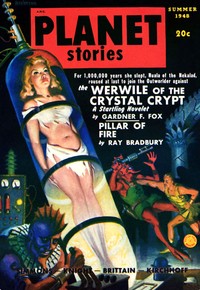
This digital edition of Pillar of Fire — A Closer Reading is described by source-level measurements including 16,760 words, 1 hr 13 min estimated reading time, and 2 detected text sections.
The text analysis averages about 10.7 words per sentence, while the detected sections provide another way to judge how the source is divided.
Project Gutenberg metadata also associates the work with “Science fiction,” connecting these edition facts with the source record’s subject description.
Explore this collection
These alternatives are selected using recorded categories and estimated reading time.
About 82 minutes
Technology Airships Imagined Futures
18,773 recorded words. 9 minutes difference from this book's estimate.
View Gutenberg source #63874About 64 minutes
Technology Airships Imagined Futures
14,643 recorded words. 9 minutes difference from this book's estimate.
View Gutenberg source #70562About 61 minutes
Technology Airships Imagined Futures
13,814 recorded words. 12 minutes difference from this book's estimate.
View Gutenberg source #51379Search stored excerpts and compare books → Choose by your preferences →
Choices use stored catalog measurements. Estimates vary with reading speed. A shared category is a catalog label, not a claim that two books have the same argument or literary quality.
Search reads excerpt text stored with this catalog and links to its associated Gutenberg record. The connection is stored in the site database; this tool does not recheck that every excerpt is word-for-word identical to that external record. Excerpt search does not cover every chapter and does not verify historical publication dates.
Catalog snapshot checked: 2026-09-25. Coverage: 98 public books, 98 available source excerpts.
Read the complete public-domain text at its original source.
Read on Project GutenbergThe story opens with a striking sensory paradox: William Lantry claws his way out of the earth, hating, but cannot breathe or smell the autumn smoke that 'burned the land down into ruin.' Bradbury immediately establishes a protagonist who is dead yet walking, a corpse animated by hatred alone. The year is 2349, and Lantry reads the stars to confirm it, calling himself 'an anachronism.' This opening does not explain how he rose; it simply presents his furious, frustrated existence.
The excerpts reveal a central tension: Lantry's supernatural abilities depend on belief. He recalls that 'as long as they believed, then so long did the dead exist.' But in 2349, people have never believed in walking dead—they incinerate corpses immediately. When Lantry tries to raise the newly dead in a warehouse, chanting and drawing blue symbols 'in the fashion of long-dead sorcerers,' nothing happens. The bodies remain 'dead and flat and cold.' Bradbury makes the horror intellectual: the dead cannot rise because the living do not imagine they can.
This is not a traditional zombie or vampire tale. The story's logic is psychological, not biological. Lantry's power is a feedback loop of faith, and in a rational future, that loop is broken. The catalog subject 'Horror tales' fits, but the horror here is metaphysical loneliness rather than gore or shock.
Lantry's defining emotion is hatred. The first line declares 'Hate was his father; hate was his mother.' He hates the living who 'lived and lived and lived' while he lay in his coffin. Yet this hatred is impotent. He cannot taste, smell, or cry. His body is a prison of withered muscles and forced breath. Bradbury emphasizes friction as the source of Lantry's warmth—a mechanical, joyless animation.
The excerpts show Lantry as a figure of pathos despite his murderous past. He is 'more alone than any man had ever been.' The story's structure, jumping from his resurrection to his failed necromancy, underscores his isolation. He is a monster without a monster's traditional power, stranded in a world that has no place for him.
Bradbury sketches the future lightly but effectively. The year 2349 is a 'numeral, a sum'—abstract and unromantic. Technology appears in passing: 'beetles' hiss on streets, bodies are trundled to 'the Incinerator.' There is no wonder, only efficiency. The graveyard is 'cold and empty,' and the warehouse where Lantry attempts his ritual is filled with steel beams and shadow.
The catalog subject 'Science fiction' is apt, but the future is backdrop, not focus. Bradbury uses it to strip away superstition. The setting is a rationalist world that has no vocabulary for the supernatural. This makes Lantry's existence a logical contradiction he cannot resolve. The story's power lies in this collision: a Gothic revenant in a world that has outgrown Gothic fears.
The excerpts end with a white-haired man entering the warehouse, observing Lantry without fear. This intrusion suggests the story may pivot from internal horror to confrontation. Readers should attend to how Bradbury balances Lantry's subjective experience—his hatred, his failed magic—with the external world's calm disbelief. The tale is brief, but its premise rewards attention to the rules Bradbury sets for his resurrected protagonist.
I remember the hush that fell when I first read Bradbury’s Lantry, his rage dissolving into a lonely whisper against a world that simply stopped believing him. It made me think of an older, stranger echo, where faith itself was the only currency. That same quiet ache surfaces in The Mummy! A Tale of the Twenty-Second Century — Key Ideas to Explore, a longing for connection that no machine can answer.
Answer a few questions and save a private reflection on this device.