About 207 minutes
The Clockwork Man — Background and Themes
Technology Airships Imagined Futures
47,601 recorded words. 4 minutes difference from this book's estimate.
View Gutenberg source #60374
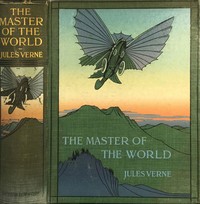
The catalog record for The Master of the World — Edition Insights provides practical reading context through 46,486 words, 3 hr 23 min estimated reading time, and 19 detected text sections.
The text analysis averages about 15.9 words per sentence, while the detected sections provide another way to judge how the source is divided.
Project Gutenberg metadata also associates the work with “Science fiction,” connecting these edition facts with the source record’s subject description.
Explore this collection
These alternatives are selected using recorded categories and estimated reading time.
About 207 minutes
Technology Airships Imagined Futures
47,601 recorded words. 4 minutes difference from this book's estimate.
View Gutenberg source #60374About 192 minutes
Technology Airships Imagined Futures
44,109 recorded words. 11 minutes difference from this book's estimate.
View Gutenberg source #51783About 217 minutes
Technology Airships Imagined Futures
49,683 recorded words. 14 minutes difference from this book's estimate.
View Gutenberg source #1284Search stored excerpts and compare books → Choose by your preferences →
Choices use stored catalog measurements. Estimates vary with reading speed. A shared category is a catalog label, not a claim that two books have the same argument or literary quality.
Search reads excerpt text stored with this catalog and links to its associated Gutenberg record. The connection is stored in the site database; this tool does not recheck that every excerpt is word-for-word identical to that external record. Excerpt search does not cover every chapter and does not verify historical publication dates.
Catalog snapshot checked: 2026-09-25. Coverage: 98 public books, 98 available source excerpts.
Read the complete public-domain text at its original source.
Read on Project GutenbergJules Verne's The Master of the World opens with a federal police inspector recounting events he himself finds hard to believe. The narrator, head inspector in the Washington police department, immediately establishes a tension between official credibility and personal wonder: he asks readers to trust his word even as he admits he can scarce believe it all himself. This framing device—a professional investigator wrestling with the inexplicable—shapes the entire narrative. The story begins in the Blue Ridge Mountains of North Carolina, at a peak called the Great Eyrie, where local residents notice birds behaving oddly: on certain days they mount higher, circle, and fly away with harsh cries. The mystery of the Great Eyrie soon connects to a far larger enigma, a vehicle called the Terror that travels by land, water, and air.
The narrator's opening words reveal a man caught between his professional duty and the strangeness of what he has witnessed. He is a head inspector in the federal police, a role that implies reliability, yet he confesses that the pictures in his memory may dwell only in his imagination. This self-doubt recurs throughout the excerpts: he asks readers to believe him, but adds that if they do not, so be it. The effect is to make the reader a partner in weighing evidence rather than a passive recipient of facts. Verne uses this technique to heighten the mystery: the more the narrator insists on his own credibility, the more the reader suspects that the truth may be stranger than any official report could contain. The narrator's voice is methodical, almost legalistic, yet it trembles with the pressure of the inexplicable.
The excerpts are dense with geographical description—not as decoration, but as a form of evidence. The Great Eyrie is described in precise detail: its huge rounded form, its rocky and grim inaccessibility, its peculiar blue effect under certain atmospheric conditions. The narrator even speculates about the name, noting that the mountain might better be called a crater. Later, when the investigation moves to Lake Erie, the text pauses for a full paragraph on the lake's surface area, depth, elevation, and connecting rivers. This is not idle geography; it is the raw material of detection. The narrator explains that such knowledge is necessary for understanding the events to come. The landscape becomes a puzzle to be read: the behavior of birds, the shape of a mountain, the depth of a lake—all may hold clues to the Terror's movements. Verne treats the American wilderness as a vast crime scene.
Throughout the excerpts, the Terror remains a shifting, elusive entity. It is first a submarine rising from Lake Erie, then a vehicle that travels on land and water, and later something that can apparently fly. The narrator and his colleague Arthur Wells pursue it, but they never fully see it or understand its capabilities. The machine is known only through its effects: the strange behavior of birds, the reports from different locations, the brief glimpse of two men stepping ashore. Verne withholds the machine's full nature, forcing the reader to piece together clues alongside the investigator. This technique creates a sense of mounting unease. The Terror is not just a vehicle; it is a symbol of technology that outpaces human understanding and control. The narrator's frustration is palpable: he is a professional who has solved many mysteries, but this one seems to resist all rational explanation.
Readers approaching The Master of the World should attend closely to the narrator's voice and the landscape details. Verne builds suspense not through action alone, but through the slow accumulation of precise observations that gradually reveal a larger pattern. The story rewards patience and a willingness to follow the evidence where it leads—even if the final answer remains tantalizingly out of reach.
There’s something steadying about following Verne’s inspector—his methodical pursuit across those precise landscapes feels almost like revisiting an old map. It reminds me of flipping through an aged anthology, where every entry holds its own patient insistence on place. That same unhurried attention lingers in Southern Literature From 1579-1895 A comprehensive review, with copious extracts and criticisms for the use of schools and the general reader — Themes and Context, a volume that feels more like a remembered porch than a textbook. Both simply ask you to sit a while.
Answer a few questions and save a private reflection on this device.