About 203 minutes
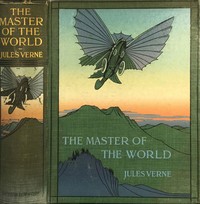
The Master of the World — Edition Insights
Technology Airships Imagined Futures
46,486 recorded words. 4 minutes difference from this book's estimate.
View Gutenberg source #3809
For The Clockwork Man — Background and Themes, the stored edition analysis reports 47,601 words, 3 hr 27 min estimated reading time, and 5 detected text sections.
The text analysis averages about 15.4 words per sentence, while the detected sections provide another way to judge how the source is divided.
Project Gutenberg metadata also associates the work with “Science fiction,” connecting these edition facts with the source record’s subject description.
Explore this collection
These alternatives are selected using recorded categories and estimated reading time.
About 203 minutes
Technology Airships Imagined Futures
46,486 recorded words. 4 minutes difference from this book's estimate.
View Gutenberg source #3809About 217 minutes
Technology Airships Imagined Futures
49,683 recorded words. 10 minutes difference from this book's estimate.
View Gutenberg source #1284About 192 minutes
Technology Airships Imagined Futures
44,109 recorded words. 15 minutes difference from this book's estimate.
View Gutenberg source #51783Search stored excerpts and compare books → Choose by your preferences →
Choices use stored catalog measurements. Estimates vary with reading speed. A shared category is a catalog label, not a claim that two books have the same argument or literary quality.
Search reads excerpt text stored with this catalog and links to its associated Gutenberg record. The connection is stored in the site database; this tool does not recheck that every excerpt is word-for-word identical to that external record. Excerpt search does not cover every chapter and does not verify historical publication dates.
Catalog snapshot checked: 2026-09-25. Coverage: 98 public books, 98 available source excerpts.
Read the complete public-domain text at its original source.
Read on Project GutenbergThe novel opens on a cricket field, where Doctor Allingham's concentration is broken by a figure that appears abruptly on the horizon, its movements described as 'violently ataxic' and its arms 'revolving like the sails of a windmill.' This intrusion of the mechanical into a pastoral English scene establishes a recurring structural pattern: the everyday world is repeatedly interrupted by the inexplicable. The cricket match itself becomes a microcosm of order disrupted, with the doctor's shattered wicket symbolizing a fracture in the expected flow of events.
The narrative relies on sudden appearances to jolt both characters and readers. The clockwork man first materializes on a hilltop, then later in the text we see Doctor Allingham returning home to find a 'young lady' waiting—another unexpected arrival. These entrances are not merely plot devices; they mirror the novel's concern with the intrusion of the future into the present. The doctor's irritation at the cricket interruption—'his irritation boiled over and produced a sense of ungovernable, childish rage'—contrasts with his later intellectual curiosity, showing how the same event can shift from nuisance to wonder. The structure thus moves between mundane irritation and philosophical speculation, often within the same scene.
Odle repeatedly describes the clockwork man's movements in mechanical terms: 'His arms revolved like the sails of a windmill. His legs shot out in all directions, enveloped in dust.' This imagery of uncontrolled, repetitive motion contrasts with the static, ordered world of Great Wymering. The doctor's own world is built on 'assumptions' and 'comfortable' routines, but the clockwork man's ataxic gestures threaten that stability. Later, when the doctor reflects on the possibility of a miracle, he notes that 'miracles were supposed to have happened at certain stages in world-history, but they were immediately obliterated by a mass of controversial comment.' The mechanical imagery thus extends beyond the physical to describe how society processes—or fails to process—the extraordinary.
The narrative frequently shifts from open, public spaces—the cricket field, the High Street—to private interiors like the doctor's house or Gregg's rooms. These transitions are marked by changes in tone and pace. On the cricket field, action is brisk and sensory; indoors, the doctor's thoughts become introspective and hesitant. For instance, after leaving Gregg, the doctor drives 'slowly along the High Street' and notes 'no sign of further disturbance.' The quiet of the town contrasts with his inner turmoil: 'It disturbed his mental equilibrium, and threatened the validity of that carefully considered world of assumptions.' This oscillation between external calm and internal disquiet structures the reader's experience, moving from public spectacle to private doubt.
Much of the narrative is filtered through Doctor Allingham's consciousness, and his voice—wry, self-deprecating, and defensive—shapes how the clockwork man is perceived. He thinks of himself as 'a miserable backslider' and reflects that 'nothing could ever compensate for the wasted years.' His irritation at the cricket interruption gives way to a reluctant acknowledgment that he will be 'dragged into the affair.' This personal, almost petty perspective prevents the fantastic from becoming purely abstract. The doctor's medical training and his desire for a 'comfortable world' create a tension between empirical observation and the desire to dismiss the inexplicable. His voice grounds the speculative elements in a recognizable human response: the urge to preserve one's worldview against disruptive evidence.
Readers attentive to structure will notice how Odle uses the clockwork man as a catalyst for examining the boundaries of the ordinary. The novel's movement between cricket-field comedy and philosophical unease rewards those who track the recurrence of mechanical imagery and the doctor's shifting moods. The excerpts suggest a work that is as much about the psychology of encountering the new as it is about time travel or cyborgs.
Reading about the mechanical man disturbing that quiet cricket match, I remembered afternoons at my grandfather’s house, the radio murmuring while life felt suspended. There’s a similar ache in The Creatures That Time Forgot — Background and Themes—that same unsettling shift from pastoral peace to something older and stranger, like finding a watch ticking inside a hollow tree.
Build a private reading journal entry for this title.