About 862 minutes
The Mysterious Island — Reading Companion
Technology Airships Imagined Futures
198,236 recorded words. 117 minutes difference from this book's estimate.
View Gutenberg source #1268
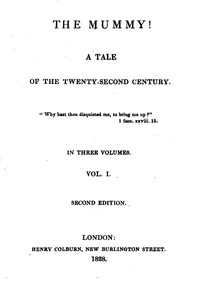
The Mummy! A Tale of the Twenty-Second Century — Key Ideas to Explore can be approached with a clearer sense of reading commitment from its source measurements: 171,309 words, 12 hr 25 min estimated reading time, and 14 detected text sections.
The text analysis averages about 22.0 words per sentence, while the detected sections provide another way to judge how the source is divided.
Project Gutenberg metadata also associates the work with “Science fiction,” connecting these edition facts with the source record’s subject description.
Explore this collection
These alternatives are selected using recorded categories and estimated reading time.
About 862 minutes
Technology Airships Imagined Futures
198,236 recorded words. 117 minutes difference from this book's estimate.
View Gutenberg source #1268About 591 minutes
Technology Airships Imagined Futures
135,702 recorded words. 154 minutes difference from this book's estimate.
View Gutenberg source #27279About 432 minutes
Technology Airships Imagined Futures
99,151 recorded words. 313 minutes difference from this book's estimate.
View Gutenberg source #44307Search stored excerpts and compare books → Choose by your preferences →
Choices use stored catalog measurements. Estimates vary with reading speed. A shared category is a catalog label, not a claim that two books have the same argument or literary quality.
Search reads excerpt text stored with this catalog and links to its associated Gutenberg record. The connection is stored in the site database; this tool does not recheck that every excerpt is word-for-word identical to that external record. Excerpt search does not cover every chapter and does not verify historical publication dates.
Catalog snapshot checked: 2026-09-25. Coverage: 98 public books, 98 available source excerpts.
Read the complete public-domain text at its original source.
Read on Project GutenbergThe narrator of The Mummy! opens by confessing a creative dilemma: heroes are “so monotonous, so dreadfully insipid.” This self-aware frustration sets the tone for a novel that deliberately breaks from convention. Published in 1827, the story leaps to the twenty-second century, where a reanimated Egyptian mummy named Cheops becomes a catalyst for political and personal upheaval. The excerpts reveal a work that is part Gothic thriller, part political satire, and part feminist thought experiment. Queen Elvira, elected to the throne, attempts to reform a corrupt system with the help of Lord Edmund, while her rival Rosabella schemes in the background. The narrative voice shifts between ironic commentary and earnest reformist zeal, creating a distinctive hybrid of genres.
The introduction is unusually meta-fictional. The narrator walks through a landscape described as “a Claude Lorraine scene,” yet this picturesque setting does not spark inspiration. Instead, the narrator complains that “the deep mine of invention cannot be worked out.” This playful despair is a deliberate contrast to the ambitious world-building that follows. The epigraph from 1 Samuel — “Why hast thou disquieted me, to bring me up?” — hints at the mummy’s reluctant return, but also at the author’s own act of resurrecting an ancient figure in a futuristic setting. The narrator’s voice is conversational and self-deprecating, a far cry from the omniscient tone typical of Gothic novels. This framing suggests that the novel is as much about the act of storytelling as it is about the story itself.
Queen Elvira’s reforms are described with a mixture of admiration and irony. She establishes a monthly petition day in “the grand square at Blackheath,” walking among her subjects to receive their complaints. The ideal is noble, but the execution falters: the petitions are handed to Lords Noodle and Doodle, who deposit them in bags “from which they would probably never again have emerged.” The satirical names underscore a skepticism about bureaucratic efficiency. Yet the people are satisfied by “the show” — the spectacle of access, not its substance. This tension between democratic ideals and practical failure is a recurring pattern. Elvira herself is portrayed as earnest but perhaps naive, while Edmund possesses “the penetrating mind and commanding genius” that actually drives change. The novel thus questions whether good governance depends on institutions or on exceptional individuals.
Rosabella, the rival queen, adapts her behavior to circumstance: “Taught by the late events not to rely too confidently upon her own strength, she rushed into the opposite extreme, and descended even unto servility.” This chameleon-like quality contrasts with Elvira’s inflexible sense of justice. The narrative notes that Elvira “had many qualities worthy of her rank,” including “nobleness in forgetting injuries.” Yet her focus on reform leaves her unaware of the “defection” of nobles who rally to Rosabella. The political landscape is thus shaped by performance — Rosabella’s calculated humility, Elvira’s ceremonial processions, and the lords’ indignation at being “subalterns where they had hoped to be commanders.” The novel presents power as a stage, where visibility and perception often outweigh substance.
Readers approaching The Mummy! should expect a work that resists easy categorization. The Gothic elements — a reanimated corpse, ancient curses — coexist with sharp political commentary and a surprisingly modern narrative voice. Pay attention to the contrasts: between the narrator’s self-mockery and the earnest reformism of the plot, between spectacle and substance in governance, and between the two queens’ strategies. The excerpts offer only a partial view, but they reveal a novel that is as interested in the mechanics of storytelling as in the future it imagines.
Loudon’s mummy, I recall, never quite woke to astonishment, but to a weary familiarity with power’s nonsense. That same quiet, unimpressed eye peers from The Description of a New World, Called the Blazing-World — Text and Context, where a lady builds a universe and mostly sighs at her courtiers. Two centuries of women, politely rearranging the script. A lovely, stubborn kinship.
Your answers remain private and are stored only in this browser.