About 288 minutes
The Moon Maid — A Closer Reading
Technology Airships Imagined Futures
66,185 recorded words. 20 minutes difference from this book's estimate.
View Gutenberg source #59752
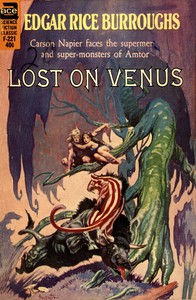
The source record for Lost on Venus — Context and Discussion measures this digital text at 70,818 words, 5 hr 8 min estimated reading time, and 23 detected text sections.
The text analysis averages about 16.0 words per sentence, while the detected sections provide another way to judge how the source is divided.
Project Gutenberg metadata also associates the work with “Science fiction,” connecting these edition facts with the source record’s subject description.
Explore this collection
These alternatives are selected using recorded categories and estimated reading time.
About 288 minutes
Technology Airships Imagined Futures
66,185 recorded words. 20 minutes difference from this book's estimate.
View Gutenberg source #59752About 283 minutes
Technology Airships Imagined Futures
65,075 recorded words. 25 minutes difference from this book's estimate.
View Gutenberg source #70195About 361 minutes
Technology Airships Imagined Futures
83,003 recorded words. 53 minutes difference from this book's estimate.
View Gutenberg source #42989Search stored excerpts and compare books → Choose by your preferences →
Choices use stored catalog measurements. Estimates vary with reading speed. A shared category is a catalog label, not a claim that two books have the same argument or literary quality.
Search reads excerpt text stored with this catalog and links to its associated Gutenberg record. The connection is stored in the site database; this tool does not recheck that every excerpt is word-for-word identical to that external record. Excerpt search does not cover every chapter and does not verify historical publication dates.
Catalog snapshot checked: 2026-09-25. Coverage: 98 public books, 98 available source excerpts.
Read the complete public-domain text at its original source.
Read on Project GutenbergThe second volume of Carson Napier's Amtor adventures opens not with a rocket launch but with a quiet, revealing conversation in a tree. Stranded with Nalte, a daughter of a jong, Carson reflects on the customs that forbid Duare from speaking of love until age twenty. Nalte's immediate challenge—'Love does not come or go in accordance with any laws or customs'—sets up a persistent tension between Earth-born expectations and Venusan realities. The excerpt shows Burroughs using dialogue to expose cultural friction rather than action, a pattern that recurs throughout the novel.
The excerpt hinges on a single, pointed exchange about love and age. Carson explains that Duare, as a jong's daughter under twenty, could not admit love even if she felt it. Nalte, also nineteen and a jong's daughter, flatly rejects this: 'if I loved a man I should say so.' The contradiction is not resolved; instead, it reveals that Venusan societies are not monolithic. Nalte's own customs—where men wait for a woman's declaration—are presented as equally binding but opposite. This difference drives the narrative forward: Carson's confusion about whom to trust and how to act becomes a recurring obstacle, more immediate than any beast or landscape.
Burroughs places his characters in a deliberately confined natural setting. The tree sanctuary, the river, the 'dim forest aisles'—these are not just backdrops but pressure points. In the excerpt, the night sounds of hunting beasts and the murmuring river frame a personal confession. Nalte's question 'Do you think me lovely?' and her soft admission 'I like to hear you say it' occur within a paragraph that begins with roars and ends with sleep. The juxtaposition of danger and vulnerability is precise: the forest isolates the pair, forcing a directness that palace corridors would forbid. The setting does not merely host the drama; it shapes the emotional register.
Duare, though absent, dominates Carson's thoughts. Yet Nalte's voice in the excerpt is more immediate and more assertive. She laughs at his explanations, tosses her head, and declares she would 'make' a man love her. Her physical description—'slender and dark, with an olive skin and a mass of black hair in lovely disorder'—is matched by a psychological directness. She reads Carson's mood ('It must be sad to lose one's mate') and steers the conversation toward her own desires. This contrast is structural: Duare is defined by absence and prohibition, Nalte by presence and permission. The reader, like Carson, is left weighing two models of Venusan womanhood, neither fully knowable from the excerpt alone.
Readers approaching Lost on Venus should attend to how Burroughs uses dialogue to expose cultural rules rather than merely advance plot. The excerpt offers no resolution to the Duare–Nalte tension, and the novel's middle sections likely sustain this ambiguity. Pay particular attention to moments when Carson's Earth assumptions are corrected or contradicted by Venusan characters—these are the hinges on which the adventure turns.
Reading about Carson’s tangled loyalties on Venus, I kept drifting back to a quieter memory of Prospector's Special — Text and Context. It has that same sense of a man learning that honesty often costs more than he expected, yet somehow leaving him lighter for it. Nalte’s frankness reminded me of that book’s dusty, patient truths.
Save your reaction, strongest insight, and memorable passage.