About 58 minutes
And Gone Tomorrow — A Reader’s Guide
Technology Airships Imagined Futures
13,277 recorded words. 8 minutes difference from this book's estimate.
View Gutenberg source #58784
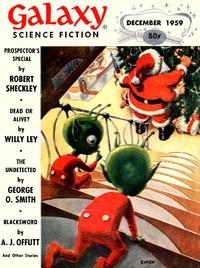
Before opening Prospector's Special — Text and Context, the edition data offers a quick orientation: 11,363 words, 50 min estimated reading time, and 2 detected text sections.
The text analysis averages about 11.4 words per sentence, while the detected sections provide another way to judge how the source is divided.
Project Gutenberg metadata also associates the work with “Science fiction,” connecting these edition facts with the source record’s subject description.
Explore this collection
These alternatives are selected using recorded categories and estimated reading time.
About 58 minutes
Technology Airships Imagined Futures
13,277 recorded words. 8 minutes difference from this book's estimate.
View Gutenberg source #58784About 61 minutes
Technology Airships Imagined Futures
13,814 recorded words. 11 minutes difference from this book's estimate.
View Gutenberg source #51379About 37 minutes
Technology Airships Imagined Futures
8,320 recorded words. 13 minutes difference from this book's estimate.
View Gutenberg source #64172Search stored excerpts and compare books → Choose by your preferences →
Choices use stored catalog measurements. Estimates vary with reading speed. A shared category is a catalog label, not a claim that two books have the same argument or literary quality.
Search reads excerpt text stored with this catalog and links to its associated Gutenberg record. The connection is stored in the site database; this tool does not recheck that every excerpt is word-for-word identical to that external record. Excerpt search does not cover every chapter and does not verify historical publication dates.
Catalog snapshot checked: 2026-09-25. Coverage: 98 public books, 98 available source excerpts.
Read the complete public-domain text at its original source.
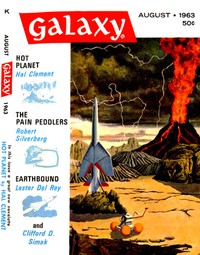
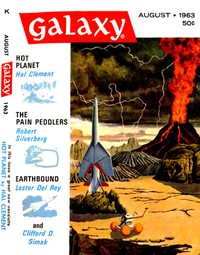
Read on Project GutenbergThe story opens with Morrison driving a sandcar across Venus's Scorpion Desert, its six fat wheels rising and falling like the ponderous rumps of tandem elephants. Sheckley establishes a voice that oscillates between gritty realism and wry humor: the protagonist fights sleep, recalls warnings about sandwolf packs and voracious birds, and reminds himself that traveling alone means half the supplies and no accidental murders. The prose is lean, with concrete details—a dead-white sky, a polaroid windshield, a compass course—that ground the science-fiction setting in tactile, mundane experience.
Sheckley uses dialogue not merely to advance plot but to create escalating, almost bureaucratic frustrations. When Morrison finally reaches a human voice on his disconnected telephone, he speaks to Mr. Boyard, the District Supervisor of the Venus Telephone Company. Boyard's lines are clipped and procedural: Your bill is two months overdue; I am a businessman, not a jeweler. The exchange turns on a misunderstanding of goldenstone—Morrison's handful of pebbles is dismissed as a trick. The humor is dry and situational: the prospector who has survived twenty-one days in the desert cannot convince a telephone supervisor that he holds a fortune. Later, the robot postman Williams 4 delivers birthday greetings and salt-water taffy, remarking Not very satisfactory under the circumstances. The dialogue consistently undercuts Morrison's desperation with mundane, rule-bound responses.
The Scorpion Desert is described through sensory contrasts: the hidden sun beats down from a dead-white sky, pouring heat into the canvas top, reflecting heat back from parched sand. Sheckley emphasizes the landscape's monotony—rolling dunes, humpbacked little waves, house-sized boulders—but also its lethal specificity. Morrison knows about sunblindness, heat-stroke, and telephone breakdown, yet the desert's real threat is the erosion of will: twenty-one days of fighting sleep while the sandcar rocks with treacherous gentleness. The setting is both vast and claustrophobic, a waterless waste three times the area of the Sahara. Sheckley avoids exoticizing Venus; instead, he makes it feel like an extreme version of Earth's own deserts, where the real enemy is exhaustion and the failure of technology.
The narrative is built on a pattern of crisis and absurd relief. Morrison's sandcar breaks down, he falls into a ravine, sandwolves charge, and kites circle overhead. Each time, a solution arrives from an unexpected direction—a robot messenger, a birthday package, a last-minute telephone call. Sheckley controls pacing through short, declarative sentences: He put the instrument down and surveyed his situation; Whirling around, he saw a huge old wolf in full charge. The action is punctuated by moments of dark comedy, as when Morrison blasts off the top of a wolf's head and thinks I was going to save that bullet for myself. The rhythm keeps the reader off-balance, never sure whether the next beat will be survival or farce.
Sheckley invests ordinary objects with outsized significance. Morrison's grubstake of twenty thousand dollars is reduced to ten dollars, which buys a single drink in Presto. The sandcar's six fat wheels, the compass course, the radio that only hums—each item is a fragile link to civilization. The most striking recurring detail is the telephone: disconnected for an unpaid bill, it becomes Morrison's only hope, and its failure drives the plot. The birthday package from Aunt Mina—a large box of salt-water taffy from Atlantic City—is a perfect Sheckley touch: a sentimental gift that is useless against sandwolves. These objects are not props but active agents in the story, their inadequacy highlighting the gap between human intention and the desert's indifference.
Readers should attend to how Sheckley balances the genre expectations of a survival story with a tone that never takes itself too seriously. The prose rewards attention to small, precise details—the way a sandcar lurches, the exact wording of a telephone supervisor's refusal. The story's humor is not a distraction but a structural principle, making the moments of genuine tension land harder. Approach this as a study in how a writer can use limited resources—a single setting, a handful of characters, a tight word count—to create a world that feels both dangerous and oddly familiar.
That rainy afternoon, Sheckley’s lonely prospector kept me company, his absurd taffy and ringing phone feeling oddly tender against the Venusian waste. Afterwards, I found myself thinking about loneliness as a kind of landscape, which is how I wandered into The Moon Maid — A Closer Reading, where the silence felt just as weighty, just as strangely warm.
Create a short personal record of your experience with this book.