About 242 minutes
The Coxswain's Bride; also, Jack Frost and Sons; and, A Double Rescue — Themes and Context
Wandering Heroes Classic Adventures
55,539 recorded words. 13 minutes difference from this book's estimate.
View Gutenberg source #21725
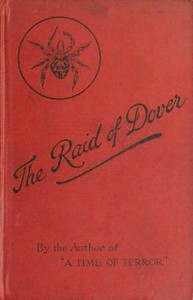
The catalog record for The Raid of Dover: A Romance of the Reign of Woman, A.D. 1940 — A Reader’s Guide provides practical reading context through 58,641 words, 4 hr 15 min estimated reading time, and 6 detected text sections.
The text analysis averages about 18.0 words per sentence, while the detected sections provide another way to judge how the source is divided.
Project Gutenberg metadata also associates the work with “Imaginary wars and battles -- Fiction,” connecting these edition facts with the source record’s subject description.
Explore this collection
These alternatives are selected using recorded categories and estimated reading time.
About 242 minutes
Wandering Heroes Classic Adventures
55,539 recorded words. 13 minutes difference from this book's estimate.
View Gutenberg source #21725About 287 minutes
Wandering Heroes Classic Adventures
65,943 recorded words. 32 minutes difference from this book's estimate.
View Gutenberg source #76622About 319 minutes
Wandering Heroes Classic Adventures
73,339 recorded words. 64 minutes difference from this book's estimate.
View Gutenberg source #62639Search stored excerpts and compare books → Choose by your preferences →
Choices use stored catalog measurements. Estimates vary with reading speed. A shared category is a catalog label, not a claim that two books have the same argument or literary quality.
Search reads excerpt text stored with this catalog and links to its associated Gutenberg record. The connection is stored in the site database; this tool does not recheck that every excerpt is word-for-word identical to that external record. Excerpt search does not cover every chapter and does not verify historical publication dates.
Catalog snapshot checked: 2026-09-25. Coverage: 98 public books, 98 available source excerpts.
Read the complete public-domain text at its original source.
Read on Project GutenbergThe novel opens with an author's note that frames the story as a 'Forecast in Fiction' driven by patriotism, not pessimism. It explicitly links three causes—socialism, the 'Revolt of Woman,' and weakened maritime power—to a feared national downfall. This polemical preface sets a tone of urgent warning, but the narrative itself often retreats into romantic and sublime set pieces.
The excerpt from a balloon ascent at sunrise shows a shift into lyrical, almost transcendental description. The protagonist Linton observes London reduced to a 'winding ditch' and St. Paul's a 'thimble,' a perspective that dwarfs human concerns. This oscillation between political argument and aesthetic contemplation defines the book's peculiar rhythm.
The balloon voyage in the excerpt is the novel's most sustained piece of descriptive writing. It moves from precise altitude measurements—9,000 feet, 13,000 feet—to rhapsodic imagery: 'an illimitable molten sea' of clouds, 'roseate violet' light. The narrator dwells on the contrast between the sublime view and the triviality of human works below. Yet this escape into beauty is immediately undercut by the story's political frame. The author's note warns that England is being 'wounded by Englishmen,' and the balloon's serene ascent may be a temporary reprieve from the coming catastrophe. The text thus alternates between two registers: the panoramic, almost mystical, and the narrowly partisan.
When Linton descends to visit Zenobia after her father's death, the prose contracts into a hushed, sentimental register. The scene is marked by short, halting exchanges: 'You understand how much I feel for you,' he said. 'Yes,' she answered gratefully, 'It was good of you to come.' The narrator describes Zenobia as 'a slim, sad figure' in black, her pallor heightened by dim light. This is the language of Victorian romance, not political polemic. The contrast with the balloon's cosmic scale is jarring. The novel seems to house two incompatible voices: one reaching for the sublime, the other confined to drawing-room pathos. Whether these registers eventually merge or remain in tension is not clear from the excerpts.
The excerpts reveal abrupt changes in pace. The balloon ascent unfolds in long, flowing sentences that mimic the slow drift of the craft: 'Higher and higher rose the Bladud, a tiny speck in the midst of the immeasurable clouds.' Time seems suspended. Then, with the descent, the narrative accelerates. The death of Zenobia's father is reported in a single terse sentence: 'The blinds were down.' The subsequent dialogue is clipped, with pauses marked by 'He waited quietly' and 'Zenobia paused for a moment.' This rhythmic shift from expansive to compressed suggests a deliberate technique: the sublime panorama gives way to the intimate, hurried moment. The novel may use these contrasts to mirror the instability of its imagined world.
Readers should attend to how the novel manages its dual identity as political warning and romantic fiction. The balloon passage, with its careful layering of visual detail and philosophical reflection, may be the book's most accomplished writing. The dialogue, by contrast, relies on conventional gestures. Noticing when the prose expands or contracts—and what triggers those changes—will reveal the work's internal logic better than any summary of its plot.
I’ve always found the anxious skies over Dover in that old 1910 romance to harbor a peculiar stillness—as if the whole nation held its breath. That same quiet unease lingers in Fearful Rock — Story, Setting & Ideas, where the land itself seems to harbor forgotten warnings. Both feel like whispered histories of places, never quite at peace with their own pasts. A certain kinship of tremor, I suppose.
Save your reaction, strongest insight, and memorable passage.