About 539 minutes
The Lion of Saint Mark: A Story of Venice in the Fourteenth Century — Edition Insights
Wandering Heroes Classic Adventures
123,748 recorded words. 28 minutes difference from this book's estimate.
View Gutenberg source #17546
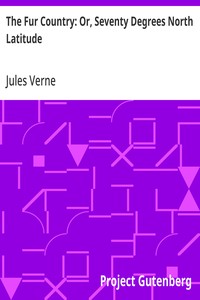
For The Fur Country: Or, Seventy Degrees North Latitude — A Closer Reading, the stored edition analysis reports 130,341 words, 9 hr 27 min estimated reading time, and 16 detected text sections.
The text analysis averages about 22.4 words per sentence, while the detected sections provide another way to judge how the source is divided.
Project Gutenberg metadata also associates the work with “Survival -- Fiction,” connecting these edition facts with the source record’s subject description.
Explore this collection
These alternatives are selected using recorded categories and estimated reading time.
About 539 minutes
Wandering Heroes Classic Adventures
123,748 recorded words. 28 minutes difference from this book's estimate.
View Gutenberg source #17546About 621 minutes
Wandering Heroes Classic Adventures
142,700 recorded words. 54 minutes difference from this book's estimate.
View Gutenberg source #3726About 435 minutes
Wandering Heroes Classic Adventures
99,958 recorded words. 132 minutes difference from this book's estimate.
View Gutenberg source #53370Search stored excerpts and compare books → Choose by your preferences →
Choices use stored catalog measurements. Estimates vary with reading speed. A shared category is a catalog label, not a claim that two books have the same argument or literary quality.
Search reads excerpt text stored with this catalog and links to its associated Gutenberg record. The connection is stored in the site database; this tool does not recheck that every excerpt is word-for-word identical to that external record. Excerpt search does not cover every chapter and does not verify historical publication dates.
Catalog snapshot checked: 2026-09-25. Coverage: 98 public books, 98 available source excerpts.
Read the complete public-domain text at its original source.
Read on Project GutenbergFrom its opening pages, The Fur Country establishes a deliberate, almost bureaucratic tone: Lieutenant Hobson and his men are dispatched by the Hudson's Bay Company to build a fort at the seventieth parallel, and the early chapters read like a logistical report. The translator, N. D'Anvers, preserves Verne's fondness for precise measurements and catalogues—supplies, latitudes, distances—that create an illusion of control. Yet the excerpts reveal a subtle shift in narrative voice as the expedition settles into Fort Hope. The prose begins to linger on sensory details: the "heavy mists" that obscure landmarks, the "apparently firm and motionless" ground. These small observations, repeated across chapters, quietly undermine the initial confidence, preparing the reader for the story's central rupture.
The novel's pacing is deceptive. For much of the text, Verne builds a rhythm of routine: hunting parties, astronomical observations, the daily management of the fort. The language remains matter-of-fact, even when describing a volcanic eruption or a walrus hunt. But the excerpts show how the narrative voice begins to accumulate anomalies. Lieutenant Hobson notices that the isthmus connecting their peninsula to the mainland has "been snapped in two by a subterranean convulsion." The phrasing is clinical, yet the implication is catastrophic. Verne withholds dramatic exclamation; instead, he lets the detail sit within a longer paragraph about the thaw. This structural choice—placing the revelation amid mundane description—mirrors the characters' own delayed comprehension. The reader, like the colonists, must piece together the danger from scattered clues.
Hobson's decision to hide the truth from his men is rendered through a shift in narrative focus. The prose moves from external action to internal calculation: "Although Hobson had no doubt of the moral and physical courage... he determined not to acquaint them with the truth." The language becomes more abstract, dwelling on the Lieutenant's management of information. Meanwhile, the astronomer Thomas Black provides a contrasting voice—obsessive, single-minded, blind to everything but his failed eclipse. Verne uses Black's narrow perspective to highlight what Hobson chooses to suppress. The dialogue between them is terse; Hobson's evasions are marked by pauses and incomplete sentences. The narrative voice, once expansive, contracts to match the Lieutenant's guardedness.
The excerpts reveal a careful manipulation of pace through geographic description. Early passages move quickly across the landscape—rivers, lakes, passes—as the expedition advances. But once Fort Hope is built, the narrative slows, circling the same locations: the lagoon, the cliffs, the coast. This stasis is deliberate. Verne uses repetitive descriptions of the horizon and the ice fields to create a sense of entrapment. When the truth of the drifting island emerges, the prose accelerates again, but the sentences remain clipped: "For months this drifting had been going on unnoticed." The speed of the revelation contrasts with the earlier languor, making the danger feel both sudden and inevitable. The reader, like the colonists, must recalibrate their understanding of the landscape itself.
Readers attentive to Verne's handling of time and perspective will find that The Fur Country rewards a second reading. The early chapters, which may seem merely procedural, contain the seeds of the later crisis. Pay particular attention to moments when the narrative pauses on a detail that seems out of place—a footprint, a change in the wind, a discrepancy in latitude. These are not decorative; they are the novel's quiet signals of a world in motion.
I keep thinking about that moment in The Fur Country when the ground itself turns out to be moving, and how quietly that dread settles in. It reminded me of the strange, slow unease in Fearful Rock — Story, Setting & Ideas, where the setting starts to feel less like a place and more like a question. That lingering feeling follows you home.
Your answers remain private and are stored only in this browser.