About 214 minutes
Nine Unlikely Tales — Key Ideas to Explore
Fantasy Juvenile Worlds
49,164 recorded words. 4 minutes difference from this book's estimate.
View Gutenberg source #49913
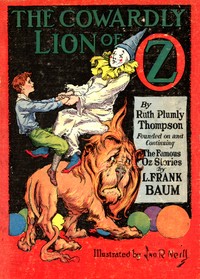
For The Cowardly Lion of Oz — Background and Themes, the stored edition analysis reports 50,116 words, 3 hr 38 min estimated reading time, and 7 detected text sections.
The text analysis averages about 15.8 words per sentence, while the detected sections provide another way to judge how the source is divided.
Project Gutenberg metadata also associates the work with “Oz (Imaginary place) -- Juvenile fiction,” connecting these edition facts with the source record’s subject description.
Explore this collection
These alternatives are selected using recorded categories and estimated reading time.
About 214 minutes
Fantasy Juvenile Worlds
49,164 recorded words. 4 minutes difference from this book's estimate.
View Gutenberg source #49913About 211 minutes
Fantasy Juvenile Worlds
48,451 recorded words. 7 minutes difference from this book's estimate.
View Gutenberg source #953About 209 minutes
Fantasy Juvenile Worlds
47,982 recorded words. 9 minutes difference from this book's estimate.
View Gutenberg source #23869Search stored excerpts and compare books → Choose by your preferences →
Choices use stored catalog measurements. Estimates vary with reading speed. A shared category is a catalog label, not a claim that two books have the same argument or literary quality.
Search reads excerpt text stored with this catalog and links to its associated Gutenberg record. The connection is stored in the site database; this tool does not recheck that every excerpt is word-for-word identical to that external record. Excerpt search does not cover every chapter and does not verify historical publication dates.
Catalog snapshot checked: 2026-09-25. Coverage: 98 public books, 98 available source excerpts.
Read the complete public-domain text at its original source.
Read on Project GutenbergRuth Plumly Thompson’s 1923 entry in the Oz series opens with a demand: “Tazzywaller, I must have another lion,” says Mustafa of Mudge, tweaking his blue whiskers. The catalog subjects list the Cowardly Lion as a “Fictitious character,” but the excerpts show him as a protagonist who saves lives—pulling Notta and Bob from a cloud after they are pushed off a skyle by the Uns. The lion’s cowardice is less evident here than his resourcefulness; he winds his tail around a tree trunk to haul up the fishing lines.
The opening chapter establishes a peculiar arithmetic: Mustafa already has “nine thousand nine hundred and ninety-nine lions and a half.” The half-lion—only back legs and tail—is the result of Tazzywaller’s self-defense with a scimitar. Mustafa dismisses this as “Monstrous annoying.” The blue whiskers, tweaked in irritation, become a recurring visual marker. Thompson’s dialogue leans into absurdity: Mustafa calls the half-lion “the wrong half,” as if a lion could be correctly halved. This sets a tone where logic is elastic, but the stakes—hunting the Cowardly Lion—are real within the story’s rules.
In chapter 12, the Cowardly Lion, Notta, and Bob land on a skyle—a floating sky-island inhabited by the Uns, feather-headed creatures who push Bob and Notta off the edge. The rescue hinges on fishing lines tied to a tree, a detail that ties the fantastical setting to mundane gear. Later, Notta discovers a bird that snores so loudly it sounds like sawing wood. The bird’s beak is “long and blue, and curved,” and it boasts, “I’m the loudest snorer in the sky.” Thompson blends threat with comedy: the Uns are dangerous, but the snoring bird is merely self-important.
The book is dedicated to “My sister Dorothy Thompson Curtiss and all other lovely Dorothys including Dorothy of Oz.” In the preface, Thompson addresses readers directly: “This is the Cowardly Lion’s book, because it is mostly about him and the people who were hunting him.” She invites letters and Oz news, saying “there is always room in my letter box for just one more.” This framing positions the novel as a continuation of Baum’s series while asserting Thompson’s own voice. The excerpts show her style: brisk, conversational, and fond of parenthetical asides.
Readers should note that the excerpts cover only the opening and one middle chapter. The catalog subject “Cowardly Lion (Fictitious character)” undersells the lion’s active role; he is less a symbol of fear than a capable rescuer. Thompson’s use of blue whiskers, half-lions, and snoring birds suggests a playful approach to fantasy logic. Pay attention to how the lion’s cowardice is mentioned but not demonstrated in the available text—the full book may complicate that trait.
There’s something tender about the Cowardly Lion being hunted simply for a collection—nine thousand, nine hundred ninety-nine and a half lions, as if he were a missing trinket. It reminds me of how childhood stories often treat creatures as pieces in someone else’s game. I thought of that again while rereading The Magic Fishbone A Holiday Romance from the Pen of Miss Alice Rainbird, Aged 7 — Text and Context—another quiet tale where a small, odd thing carries more weight than anyone expects.
Build a private reading journal entry for this title.