
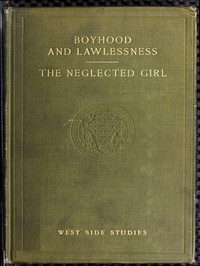
West Side Studies: Boyhood and Lawlessness; The Neglected Girl by Pauline Goldmark et al.
Read "West Side Studies: Boyhood and Lawlessness; The Neglected Girl by Pauline Goldmark et al." Online
This book is available in the public domain. Start reading the digital edition below.
Book Preview
A short preview of the book’s content is shown below to give you an idea of its style and themes.
The Story
So what's this book actually about? “West Side Studies: Boyhood and Lawlessness; The Neglected Girl” isn't a novel, but it reads like a series of true crime stories. Back in the early 1900s, a group of researchers went into poor neighborhoods in New York City—basically, parts of Manhattan that rich people ignored. They wanted to find out why so many kids were getting in trouble with the law.
They focused on two group: “lawless” boys and “neglected” girls. For each, they laid out a day-in-the-life snapshot linked to to poverty, broken homes, and an education system that failed them. Instead of branding these kids as future criminals, the book builds a case for what we now call the school-to-prison pipeline. Wars, labor abuses, skipping school—it's all here, retold as sociological study teeming with empathy.
Why You Should Read It
This isn't just a dry pile of numbers. The language is vivid and the arguments big. Honestly, reading it felt like scrolling through a sleuth’s blog—jaded, curious, ready to turn “kid caught stealing” into a lesson on broken systems. What grabbed me most? The authors didn’t just preach; they interviewed kids, visited tenements, and actually saw suffering, then called out the wealthier institutions ignoring it. You can almost hear echoes today. Characters? There's Josephine, a young girl who can’t make dresses all day and ends up in a street gang. Carlos Jr., a boy whose crime is to be hungry. Strong feels. Soul-shook.]). I found myself comparing my neighborhood’s youth programs to those from a hundred years ago.
The writers argue that society’s judgment as “criminal” or “disorderly” falls heaviest on the poor. Sound familiar? Yeah, this book makes your brain itch with questions about fairness today. It gets technical without sounding like a robot.
Final Verdict
This is for you if you love history that bites, or are dying to understand the roots of urban problems we still fight. Perfect for fans of “The New Jim Crow,” social workers, history geks, and messy human stories. You’ll walk away seeing past crime headlines into the broken outlines underneath. Take your time with it—and maybe scribble a note to your state representative.This work has been identified as being free of known copyright restrictions. You do not need permission to reproduce this work.
Paul Miller
6 months agoI took detailed notes while reading through the chapters and the author clearly has a deep mastery of the subject matter. I'll be recommending this to my students and colleagues alike.
Patricia Rodriguez
2 years agoI've been looking for a reliable source on this topic, and the author manages to bridge the gap between theory and practice effectively. An excellent example of how quality digital books should be formatted.



Linda Martin
6 months agoThe balance between academic rigor and readability is perfect.