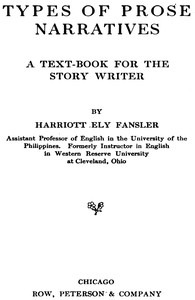
Types of Prose Narratives: A Text-Book for the Story Writer by Harriott Ely Fansler

(7 User reviews)   5452
By Robert Nguyen Posted on Dec 11, 2025
In Category - Exploration
Fansler, Harriott Ely Fansler, Harriott Ely
English
Hey, I just found this hidden gem that's basically a time capsule for writers. It's not a storybook—it's a 1912 guide that shows you how stories are built from the inside out. Think of it like finding your great-grandma's secret recipe box, but instead of cookies, it's filled with the blueprints for every kind of tale. Fansler breaks down everything from fairy tales to modern novels, showing the patterns and rules that make them work. It’s surprisingly fresh and feels like a chat with a sharp, encouraging teacher who believes anyone can learn to tell a good story. If you've ever wanted to write or just understand why your favorite books hook you, this old-school manual is a fascinating peek behind the curtain.
Share

Read "Types of Prose Narratives: A Text-Book for the Story Writer by Harriott Ely Fansler" Online

This book is available in the public domain. Start reading the digital edition below.

START READING FULL BOOK
Instant Access    Mobile Friendly

Book Preview

A short preview of the book’s content is shown below to give you an idea of its style and themes.

A list of the changes made can be found at the end of the book. Formatting and special characters are indicated as follows: [Sidenotes] _italic_ =bold= TYPES OF PROSE NARRATIVES TYPES OF PROSE NARRATIVES A TEXT-BOOK FOR THE STORY WRITER BY HARRIOTT ELY FANSLER Assistant Professor of English in the University of the Philippines. Formerly Instructor in English in Western Reserve University at Cleveland, Ohio [Illustration] CHICAGO ROW, PETERSON & COMPANY COPYRIGHT, 1911, HARRIOTT ELY FANSLER. PREFACE Inspiration for any craftsman lies in the history of his art and in a definite problem at hand. He feels his task dignified when he knows what has been done before him, and he has a starting point when he can enumerate the essentials of what he wants to produce. He then goes to his work with a zest that is in itself creative. There is a popular misconception, especially in the minds of young people and seemingly in the minds of many teachers and critics of literature, that geniuses have sprung full-worded from the brain of Jove and have worked without antecedents. There could not be to a writer a more cramping idea than that. It is the aim of the present volume to help dispel that illusion, and to set in a convenient form before students of narrative the twofold inspiration mentioned--a feeling for the past and a series of definite problems. There has been no attempt at minuteness in tracing the type developments; though there has been the constant ideal of exactness and trustworthiness wherever developments are suggested. In other words, this book is not a scrutiny of origins, but a setting forth of essentials in kinds of narratives already clearly established. The analysis that gives the essentials has, of course, the personal element in it, as all such analyses must have; but the work is the work of one mind and is at least consistent. Since I have not had the benefit of other texts on the subject (for there are none that I know of) and since the inquiry into narrative types with composition in view is thus made, put together with illustrations, and published for the first time, it has been my especial aim to exclude everything dogmatic. As can readily be seen, the details have been worked out in the actual classroom. The safe thing about the use of such a text by other instructors is the fact that they and their pupils can test the truth of the generalizations by first-hand inquiry of their own. The examples chosen from literature and here printed are specific as well as typical. They have been selected not only to illustrate general principles, but for other reasons as well--some for superior intrinsic worth; some for historical position; all because of possible inspiration. But none have been selected as models. The themes written by my present and former pupils are added for the last reason--as sure reinforcement of the inspiration, as provokers to action. Often students fail to write because there is held up to them a model, something complicated and perfect in detail. They feel their apprenticeship keenly and hesitate to attempt a likeness to a masterpiece. But, on the other hand, when they get a glimpse of history and when they see the work of a fellow tyro, they know that an equally good or even better result is within their reach and so set to work at once. The productions of pupils under this historical-illustrative method, wherever it has been tried, have been encouraging. Seldom has any one failed to present an acceptable piece of work. Once...

This is a limited preview. Download the book to read the full content.

Don't let the textbook title fool you. This isn't a dry manual. It's more like a friendly, systematic tour of the storytelling toolbox, written over a century ago. Harriott Ely Fansler takes you through the different shapes stories can take, organizing them into clear categories. She starts with simple forms like fables and parables, moves through folk tales and short stories, and arrives at the complex modern novel.

Why You Should Read It

The real charm here is the perspective. Reading this is like sitting in a 1912 writing workshop. Fansler's voice is direct and practical. She doesn't just describe story types; she shows you their mechanics—why a mystery needs certain clues, how character drives a novel. You get to see the foundational ideas that modern writing guides still use, but in their original, straightforward form. It’s a masterclass in clarity that cuts through a lot of today's writing jargon.

Final Verdict

This is a must for curious writers and serious readers who love seeing how things are made. It’s perfect for anyone who geeks out on story structure, historical perspectives on art, or wants a no-nonsense foundation in narrative craft. It’s not a page-turning novel, but for the right person, it’s just as compelling. Think of it as the classic, reliable toolkit every builder should have in the basement, even if they mostly use power tools now.


🔖 Public Domain Content

The copyright for this book has expired, making it public property. Enjoy reading and sharing without restrictions.

Margaret Smith
2 months ago

Having read this twice, the character development leaves a lasting impact. I will read more from this author.

Betty Lewis
1 year ago

I was skeptical at first, but the pacing is just right, keeping you engaged. This story will stay with me.

Noah Anderson
1 year ago

Compatible with my e-reader, thanks.

Ava Wilson
3 months ago

Beautifully written.

Emma Rodriguez
1 year ago

Not bad at all.

4.5
4.5 out of 5 (7 User reviews )

Add a Review

Your Rating *
There are no comments for this eBook.
You must log in to post a comment.
Log in


Related eBooks