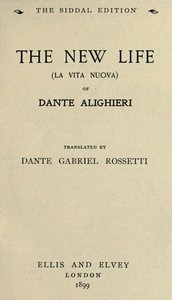
The New Life (La Vita Nuova) by Dante Alighieri

(8 User reviews)   4851
By Robert Nguyen Posted on Dec 30, 2025
In Category - Geography
Dante Alighieri, 1265-1321 Dante Alighieri, 1265-1321
English
Ever wondered what it was like to fall in love 700 years ago? Dante's 'The New Life' is your answer. It's not just a love story—it's a raw, poetic diary from a young man completely wrecked by a single glance. The mystery? It's about Beatrice. We never really get to know her, yet she changes everything. Dante charts the chaos of his own heart: the dizzying highs of seeing her, the crushing lows of her polite indifference, and the strange, spiritual turn his obsession takes. Forget knights and dragons; the real medieval drama was trying to survive your own feelings. This short book is a stunningly honest look at how love can feel like both a blessing and a curse, and how one person can redefine your entire world.
Share

Read "The New Life (La Vita Nuova) by Dante Alighieri" Online

This book is available in the public domain. Start reading the digital edition below.

START READING FULL BOOK
Instant Access    Mobile Friendly

Book Preview

A short preview of the book’s content is shown below to give you an idea of its style and themes.

Printed by Hazell, Watson, & Viney, Ld., London and Aylesbury. _PREFATORY NOTE_ Dante Gabriel Rossetti, being the son of an Italian who was greatly immersed in the study of Dante Alighieri, and who produced a Comment on the _Inferno_, and other books relating to Dantesque literature, was from his earliest childhood familiar with the name of the stupendous Florentine, and to some extent aware of the range and quality of his writings. Nevertheless—or perhaps indeed it may have been partly on that very account—he did not in those opening years read Dante to any degree worth mentioning: he was well versed in Shakespeare, Walter Scott, Byron, and some other writers, years before he applied himself to Dante. He may have been fourteen years of age, or even fifteen (May 1843), before he took seriously to the author of the _Divina Commedia_. He then read him eagerly, and with the profoundest admiration and delight; and from the _Commedia_ he proceeded to the lyrical poems and the _Vita Nuova_. I question whether he ever read—unless in the most cursory way—other and less fascinating writings of Alighieri, such as the _Convito_ and the _De Monarchiâ_. From reading, Rossetti went on to translating. He translated at an early age, chiefly between 1845 and 1849, a great number of poems by the Italians contemporary with Dante, or preceding him; and, among other things, he made a version of the whole _Vita Nuova_, prose and verse. This may possibly have been the first important thing that he translated from the Italian: if not the first, still less was it the last, and it may well be that his rendering of the book was completed within the year 1846, or early in 1847. He did not, of course, leave his version exactly as it had come at first: on the contrary, he took counsel with friends (Alfred Tennyson among the number), toned down crudities and juvenilities, and worked to make the whole thing impressive and artistic—for in such matters he was much more chargeable with over-fastidiousness than with laxity. Still, the work, as we now have it, is essentially the work of those adolescent years—from time to time reconsidered and improved, but not transmuted. Some few years after producing his translation of the _Vita Nuova_, Rossetti was desirous of publishing it, and of illustrating the volume with etchings from various designs, which he had meanwhile done, of incidents in the story. This project, however, had to be laid aside, owing to want of means, and the etchings were never undertaken. It was only in 1861 that the volume named _The Early Italian Poets_, including the translated _Vita Nuova_, was brought out: the same volume, with a change in the arrangement of its contents, was reissued in 1874, entitled _Dante and his Circle_. This book, in its original form, was received with favour, and settled the claim of Rossetti to rank as a poetic translator, or indeed as a poet in his own right. For _The Early Italian Poets_ he wrote a Preface, from which a passage, immediately relating to the _Vita Nuova_, is extracted in the present edition. There are some other passages, affecting the whole of the translations in that volume, which deserve to be borne in mind, as showing the spirit in which he undertook the translating work, and I give them here:— “The life-blood of rhythmical translation is this commandment—that a good poem shall not be turned into a bad one. The only true motive for putting poetry into a fresh language must be to endow a fresh nation, as far as possible, with...

This is a limited preview. Download the book to read the full content.

So, you've heard of Dante's Inferno, but have you met the guy who wrote it? 'The New Life' is his origin story. Written in his twenties, it's a mix of poetry and prose where he tells us about the day his life changed forever. At age nine, he meets Beatrice. At eighteen, she greets him in the street. That's it. That's the plot. But for Dante, these brief moments are earthquakes.

The Story

The book follows Dante's intense, one-sided love for Beatrice from childhood to her tragic early death. He writes poems about every emotional spike—the joy of a greeting, the despair when she ignores him, the fever dreams her image causes. He even shares the poems with friends and then explains what he really meant. After Beatrice dies, Dante is shattered. But here's the twist: his grief pushes his love beyond the earthly. He stops seeking her in the street and starts seeing her as a guiding light, a figure of divine grace. The 'new life' of the title is this spiritual awakening born from profound loss.

Why You Should Read It

I was blown away by how modern Dante's emotions feel. The social anxiety, the overthinking, the way he crafts his whole identity around someone who barely knows he exists? We've all been there (hopefully less intensely!). It's a powerful reminder that the human heart hasn't changed much. Watching his love transform from infatuation to something sacred is genuinely moving. This isn't a dusty classic; it's the vulnerable journal of the world's most famous poet.

Final Verdict

Perfect for romantics, poetry lovers, and anyone who's ever had a crush that felt world-altering. It's also a must-read if you plan to tackle The Divine Comedy—this is where Beatrice begins. At under 100 pages, it's a quick, immersive trip into the mind of a young genius, heartbreak and all.


🟢 License Information

This digital edition is based on a public domain text. It serves as a testament to our shared literary heritage.

Barbara Thompson
4 months ago

Great read!

Daniel Lee
11 months ago

After finishing this book, it challenges the reader's perspective in an intellectual way. Exceeded all my expectations.

Charles Lewis
1 year ago

After hearing about this author multiple times, the narrative structure is incredibly compelling. A valuable addition to my collection.

Matthew Brown
2 months ago

Loved it.

Carol Perez
5 months ago

Read this on my tablet, looks great.

5
5 out of 5 (8 User reviews )

Add a Review

Your Rating *
There are no comments for this eBook.
You must log in to post a comment.
Log in


Related eBooks