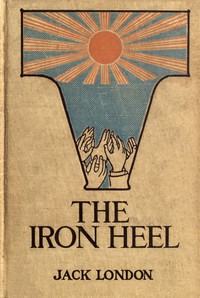
The iron heel by Jack London

(8 User reviews)   2818
By Robert Nguyen Posted on Jan 10, 2026
In Category - Exploration
London, Jack, 1876-1916 London, Jack, 1876-1916
English
Imagine you found a secret history book from the future, hidden in your attic. That's the feeling you get from Jack London's 'The Iron Heel.' It's not just a story—it's a warning. Written in 1908, it predicts a world where a few ultra-rich families crush everyone else. We follow a revolutionary named Ernest Everhard as he tries to wake people up before it's too late. The chilling part? London got so much right about how power works. It's a political thriller that reads like it was written yesterday, and it will make you look at today's headlines in a whole new, slightly terrifying, way.
Share

Read "The iron heel by Jack London" Online

This book is available in the public domain. Start reading the digital edition below.

START READING FULL BOOK
Instant Access    Mobile Friendly

Book Preview

A short preview of the book’s content is shown below to give you an idea of its style and themes.

Avis Everhard for the heroic lines upon which she modelled her husband. We know to-day that he was not so colossal, and that he loomed among the events of his times less largely than the Manuscript would lead us to believe. We know that Ernest Everhard was an exceptionally strong man, but not so exceptional as his wife thought him to be. He was, after all, but one of a large number of heroes who, throughout the world, devoted their lives to the Revolution; though it must be conceded that he did unusual work, especially in his elaboration and interpretation of working-class philosophy. “Proletarian science” and “proletarian philosophy” were his phrases for it, and therein he shows the provincialism of his mind—a defect, however, that was due to the times and that none in that day could escape. But to return to the Manuscript. Especially valuable is it in communicating to us the _feel_ of those terrible times. Nowhere do we find more vividly portrayed the psychology of the persons that lived in that turbulent period embraced between the years 1912 and 1932—their mistakes and ignorance, their doubts and fears and misapprehensions, their ethical delusions, their violent passions, their inconceivable sordidness and selfishness. These are the things that are so hard for us of this enlightened age to understand. History tells us that these things were, and biology and psychology tell us why they were; but history and biology and psychology do not make these things alive. We accept them as facts, but we are left without sympathetic comprehension of them. This sympathy comes to us, however, as we peruse the Everhard Manuscript. We enter into the minds of the actors in that long-ago world-drama, and for the time being their mental processes are our mental processes. Not alone do we understand Avis Everhard’s love for her hero-husband, but we feel, as he felt, in those first days, the vague and terrible loom of the Oligarchy. The Iron Heel (well named) we feel descending upon and crushing mankind. And in passing we note that that historic phrase, the Iron Heel, originated in Ernest Everhard’s mind. This, we may say, is the one moot question that this new-found document clears up. Previous to this, the earliest-known use of the phrase occurred in the pamphlet, “Ye Slaves,” written by George Milford and published in December, 1912. This George Milford was an obscure agitator about whom nothing is known, save the one additional bit of information gained from the Manuscript, which mentions that he was shot in the Chicago Commune. Evidently he had heard Ernest Everhard make use of the phrase in some public speech, most probably when he was running for Congress in the fall of 1912. From the Manuscript we learn that Everhard used the phrase at a private dinner in the spring of 1912. This is, without discussion, the earliest-known occasion on which the Oligarchy was so designated. The rise of the Oligarchy will always remain a cause of secret wonder to the historian and the philosopher. Other great historical events have their place in social evolution. They were inevitable. Their coming could have been predicted with the same certitude that astronomers to-day predict the outcome of the movements of stars. Without these other great historical events, social evolution could not have proceeded. Primitive communism, chattel slavery, serf slavery, and wage slavery were necessary stepping-stones in the evolution of society. But it were ridiculous to assert that the Iron Heel was a necessary stepping-stone. Rather, to-day, is it adjudged a step aside, or a step backward, to the social tyrannies...

This is a limited preview. Download the book to read the full content.

Jack London, famous for wild adventures like White Fang, took a sharp turn with this one. The Iron Heel is a political thriller disguised as a lost manuscript from a dystopian future.

The Story

The book is framed as the diary of Avis Everhard, discovered centuries later. She tells the story of her husband, Ernest, a fierce socialist thinker. In an America of the early 20th century, Ernest sees a terrifying trend: corporations and the ultra-wealthy are merging into a single, unstoppable force he calls 'The Oligarchy' or 'The Iron Heel.' He warns that they will stop at nothing—rigging elections, using private armies, crushing unions—to protect their power. The book follows his desperate attempts to organize resistance before the Oligarchy tightens its grip for good.

Why You Should Read It

This book knocked me over. London wrote it in 1908, but you could swap 'Oligarchy' for certain modern terms and it would fit right into today's news. It's not a dry political essay; it's a gripping, often brutal, story of betrayal, propaganda, and the fight for the soul of a country. Ernest isn't a perfect hero—he's angry and uncompromising—which makes him feel real. The scariest thing is how accurately London predicted tactics like media manipulation and the use of fear to control the public.

Final Verdict

This is a must-read if you love dystopian classics like 1984 or The Handmaid's Tale and want to see where some of those ideas started. It's perfect for anyone who enjoys a smart, propulsive story that also makes you think hard about power, class, and where our society might be headed. Just be warned: it’s a bleak and furious ride, but one you won't forget.


📜 Community Domain

This content is free to share and distribute. Distribute this work to help spread literacy.

Aiden White
2 months ago

Perfect.

Liam Lopez
1 year ago

Without a doubt, the clarity of the writing makes this accessible. One of the best books I've read this year.

Jackson Lopez
10 months ago

Just what I was looking for.

Deborah Johnson
8 months ago

Enjoyed every page.

Jennifer Ramirez
2 years ago

Compatible with my e-reader, thanks.

5
5 out of 5 (8 User reviews )

Add a Review

Your Rating *
There are no comments for this eBook.
You must log in to post a comment.
Log in


Related eBooks