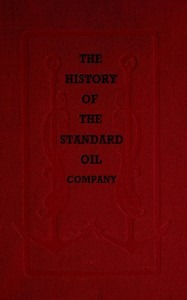
The History of the Standard Oil Company by Ida M. Tarbell

(3 User reviews)   4740
By Robert Nguyen Posted on Dec 11, 2025
In Category - Geography
Tarbell, Ida M. (Ida Minerva), 1857-1944 Tarbell, Ida M. (Ida Minerva), 1857-1944
English
Ever wonder how one company got so powerful it seemed to control the whole country? That's the story Ida Tarbell tells in 'The History of the Standard Oil Company.' Forget dry facts—this is a real-life detective story. Tarbell, a journalist, tracks how John D. Rockefeller built an empire by crushing his competition. She uncovers secret deals, railroad kickbacks, and ruthless tactics that made Standard Oil a monopoly. It's a gripping look at power, money, and the fight for fairness in business. If you think corporate drama is a modern thing, this book will blow your mind. It's the original takedown of a giant.
Share

Read "The History of the Standard Oil Company by Ida M. Tarbell" Online

This book is available in the public domain. Start reading the digital edition below.

START READING FULL BOOK
Instant Access    Mobile Friendly

Book Preview

A short preview of the book’s content is shown below to give you an idea of its style and themes.

particular trust. The Standard Oil Trust was chosen for obvious reasons. It was the first in the field, and it has furnished the methods, the charter, and the traditions for its followers. It is the most perfectly developed trust in existence; that is, it satisfies most nearly the trust ideal of entire control of the commodity in which it deals. Its vast profits have led its officers into various allied interests, such as railroads, shipping, gas, copper, iron, steel, as well as into banks and trust companies, and to the acquiring and solidifying of these interests it has applied the methods used in building up the Oil Trust. It has led in the struggle against legislation directed against combinations. Its power in state and Federal government, in the press, in the college, in the pulpit, is generally recognised. The perfection of the organisation of the Standard, the ability and daring with which it has carried out its projects, make it the pre-eminent trust of the world—the one whose story is best fitted to illuminate the subject of combinations of capital. Another important consideration with the editors in deciding that the Standard Oil Trust was the best adapted to illustrate their meaning, was the fact that it is one of the very few business organisations of the country whose growth could be traced in trustworthy documents. There is in existence just such documentary material for a history of the Standard Oil Company as there is for a history of the Civil War or the French Revolution, or any other national episode which has divided men’s minds. This has come about largely from the fact that almost constantly since its organisation in 1870 the Standard Oil Company has been under investigation by the Congress of the United States and by the Legislatures of various states in which it has operated, on the suspicion that it was receiving rebates from the railroads and was practising methods in restraint of free trade. In 1872 and again in 1876 it was before Congressional committees, in 1879 it was before examiners of the Commonwealth of Pennsylvania and before committees appointed by the Legislatures of New York and of Ohio for investigating railroads. Its operations figured constantly in the debate which led up to the creation of the Interstate Commerce Commission in 1887, and again and again since that time the Commission has been called upon to examine directly or indirectly into its relation with the railroads. In 1888, in the Investigation of Trusts conducted by Congress and by the state of New York, the Standard Oil Company was the chief subject for examination. In the state of Ohio, between 1882 and 1892, a constant warfare was waged against the Standard in the courts and Legislature, resulting in several volumes of testimony. The Legislatures of many other states concerned themselves with it. This hostile legislation compelled the trust to separate into its component parts in 1892, but investigation did not cease; indeed, in the last great industrial inquiry, conducted by the Commission appointed by President McKinley, the Standard Oil Company was constantly under discussion, and hundreds of pages of testimony on it appear in the nineteen volumes of reports which the Commission has submitted. This mass of testimony, all of it submitted under oath it should be remembered, contains the different charters and agreements under which the Standard Oil Trust has operated, many contracts and agreements with railroads, with refineries, with pipe-lines, and it contains the experiences in business from 1872 up to 1900 of multitudes of individuals. These experiences have exactly the quality of the personal...

This is a limited preview. Download the book to read the full content.

Ida Tarbell's book isn't a typical history. It's an investigation. She starts with the early days of the oil industry in Pennsylvania, when wildcatters and small refiners were everywhere. Then she shows how John D. Rockefeller and his partners at Standard Oil methodically took over. Tarbell lays out their playbook: making secret deals with railroads for lower shipping rates, buying out rivals with pressure or money, and creating a web of companies that looked independent but were all under Rockefeller's control. The story follows the rise of a monopoly so complete it dictated prices across America.

Why You Should Read It

What makes this book special is Tarbell's voice. She's not a distant historian; she's a reporter on a mission. You can feel her outrage at the unfair tactics, but she backs it all up with hard facts, interviews, and documents. She makes you see the human cost—the ruined businesses and broken dreams. It’s also a story about journalism itself. Tarbell proved that careful, persistent reporting could challenge the most powerful man in the country. Reading it today, you’ll see the roots of so many modern debates about big tech, corporate power, and antitrust laws.

Final Verdict

This is a must-read for anyone curious about power—how it's built, used, and challenged. It's perfect for history buffs who like narrative nonfiction, for business readers interested in the origins of modern capitalism, and for anyone who enjoys a brilliantly told true story. It reads like a thriller, but it's all real. A foundational piece of journalism that’s still incredibly relevant.


🔓 Open Access

This digital edition is based on a public domain text. You can copy, modify, and distribute it freely.

Emily Harris
1 year ago

Based on the summary, I decided to read it and the content flows smoothly from one chapter to the next. Exceeded all my expectations.

Dorothy Thomas
1 year ago

I started reading out of curiosity and the emotional weight of the story is balanced perfectly. This story will stay with me.

Noah Smith
1 year ago

I was skeptical at first, but the storytelling feels authentic and emotionally grounded. I would gladly recommend this title.

5
5 out of 5 (3 User reviews )

Add a Review

Your Rating *
There are no comments for this eBook.
You must log in to post a comment.
Log in


Related eBooks