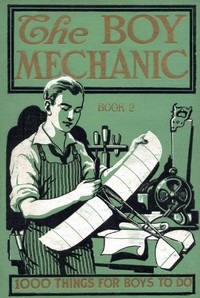
The Boy Mechanic, Book 2: 1000 Things for Boys to Do by H. H. Windsor

(5 User reviews)   4082
By Robert Nguyen Posted on Dec 11, 2025
In Category - World Cultures
English
Hey, I just finished this wild book from 1915 called 'The Boy Mechanic, Book 2.' It's not a novel—it's basically a time capsule full of 1000 projects for boys. We're talking building your own canoe from scrap wood, setting up a backyard telegraph, and even making a camera from a cigar box. It's totally nuts and charming. The main 'conflict' is between you and boredom, with instructions so old-school they feel like secret knowledge. It made me want to go build something useless and wonderful immediately. You should check it out just for the sheer, joyful chaos of pre-internet ingenuity.
Share

Read "The Boy Mechanic, Book 2: 1000 Things for Boys to Do by H. H. Windsor" Online

This book is available in the public domain. Start reading the digital edition below.

START READING FULL BOOK
Instant Access    Mobile Friendly

Book Preview

A short preview of the book’s content is shown below to give you an idea of its style and themes.

apt to lead him into the unknown and unexplored byways of the earth. Though modern surveyors often use precise and expensive instruments, creditable surveys can be made with simple and inexpensive apparatus. Of such apparatus, two of the simplest are the plane table and the camera. Since one must know the principles of plane-table surveying before he can do camera surveying, this paper will describe the plane table alone, leaving the camera for another chapter. A plane table is simply a drawing board mounted on a tripod so that it can be set up and worked upon in the field. One kind of plane table, which is used in the army for reconnaissance, does not even have a tripod; it is simply strapped to the arm of the man who is using it. Plane-table maps vary greatly in scale and the area they represent. Landscape artists' plans may show only single city lots, while some topographic maps cover hundreds of square miles on a single sheet. For maps of a small farm, a park, or a residence block in the city, a plane table is almost ideal, since plane-table maps are made with rather simple apparatus and do not require much actual measuring on the ground. Most objects are located without ever going to them, or even sending a rod-man to them. [Illustration: Just a Few Weeks After George Washington's Sixteenth Birthday, in 1748, Lord Fairfax, Owner of a Large Estate in Virginia, Took Him into His Employ as a Surveyor] Besides the plane table itself and a sheet of paper, only a small carpenter's level, a tape to measure a few distances with, and some spikes for markers, a hard lead pencil, a ruler, and a few needles are absolutely necessary for this sort of a map. [Illustration: Three Stations are Used for Setting the Plane Table in Succession to Locate the Various Objects TABLE AT STA. A - TABLE AT STA. B - TABLE AT STA. C ] To start a plane-table map, a station must first be selected from which as many as possible of the objects to be located on the finished map can be seen. Ordinarily, the objects one would locate are corners of buildings, fence corners, intersections of roads, corners of lots, banks of streams, possibly trees, and section and quarter-section corners in the country. A railroad, a lake, a mountain, or anything which forms a noticeable landmark in any particular locality, ought to be on the map. In mapping a territory which has never been surveyed before, the first surveyor may name the hills and streams. After the first station has been selected, it is marked by a pile of stones, a stake, or, if precise work is to be done, a tack in the top of a stake. The table is then set up over this station point and leveled so that the surface of the paper will be truly horizontal. Generally, too, the board is "oriented," that is, placed so that two of its edges point north and south and two east and west. It is then clamped so that it will not move while working on it. To begin the map, a point on the table is chosen to represent the station on the ground over which the table is set. This point is marked by sticking a fine needle into the paper, vertically. A small triangle should be drawn around the needle hole in the paper and labeled "Sta. A," so that it will not be lost in the maze of points which will soon cover the sheet. By...

This is a limited preview. Download the book to read the full content.

Let's be clear: this isn't a storybook. There's no plot in the traditional sense. 'The Boy Mechanic, Book 2' is a massive collection of instructions, diagrams, and ideas published in 1915. It's a snapshot of a world where 'things to do' meant using your hands, some basic tools, and whatever you could find around the house or in a junkyard.

The Story

There is no narrative. Instead, you open the book and are immediately hit with a waterfall of projects. Page one might show you how to build a sled. Page fifty explains a homemade water filter. Page two hundred details the construction of a backyard roller coaster (seriously). It jumps from practical knots to miniature steam engines to magic tricks. The 'story' is the journey from having an idea to making it real, with nothing but curiosity and elbow grease.

Why You Should Read It

I loved this book for its spirit. It assumes competence and creativity in its reader. There's a fearless, can-do attitude on every page that's incredibly refreshing today. It’s not about buying a kit; it's about understanding how things work and making them yourself. The illustrations are charmingly detailed, and the language is direct and encouraging. It made me nostalgic for a kind of hands-on play I never even experienced.

Final Verdict

Perfect for tinkerers, history lovers, and anyone tired of screen-based entertainment. It's a fantastic resource for a parent or teacher looking for classic project ideas, and a wonderful curiosity for adults who enjoy vintage how-to guides. Don't expect modern safety warnings or polished prose—expect a direct line to a more analog, inventive, and wonderfully messy way of thinking.


📜 Copyright Free

Legal analysis indicates this work is in the public domain. Feel free to use it for personal or commercial purposes.

Daniel Miller
1 month ago

After finishing this book, the author's voice is distinct and makes complex topics easy to digest. I will read more from this author.

Kenneth Allen
1 year ago

Perfect.

Nancy Allen
1 year ago

Loved it.

Emily Flores
3 months ago

Surprisingly enough, the emotional weight of the story is balanced perfectly. Definitely a 5-star read.

Sandra Lewis
1 year ago

Good quality content.

4.5
4.5 out of 5 (5 User reviews )

Add a Review

Your Rating *
There are no comments for this eBook.
You must log in to post a comment.
Log in


Related eBooks