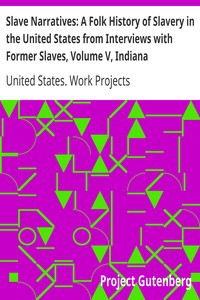
Slave Narratives: A Folk History of Slavery in the United States from…

(12 User reviews)   4983
By Robert Nguyen Posted on Jan 10, 2026
In Category - Exploration
United States. Work Projects Administration United States. Work Projects Administration
English
Hey, have you ever wondered what the stories behind the history textbooks actually sound like? This book isn't a single story—it's a collection of over 2,300 real interviews with the last generation of people who were born into slavery, recorded in the 1930s. It's not a neat, polished history. It's raw, it's messy, and it's told in their own words. You're not just reading about history; you're hearing it directly from people who lived it. The main thing here is the sheer weight of memory and the struggle to hold onto these stories before they were lost forever. It's a conversation across a century, and it will change how you think about that period completely.
Share

Read "Slave Narratives: A Folk History of Slavery in the United States from…" Online

This book is available in the public domain. Start reading the digital edition below.

START READING FULL BOOK
Instant Access    Mobile Friendly

Book Preview

A short preview of the book’s content is shown below to give you an idea of its style and themes.

names and addresses, has been incorporated into the interview headers. In some cases, information has been rearranged for readability. Names in brackets were drawn from text of interviews.] Ex-Slave Stories District No. 5 Vanderburgh County Lauana Creel AN UNHAPPY EXPERIENCE [GEORGE W. ARNOLD] This is written from an interview with each of the following: George W. Arnold, Professor W.S. Best of the Lincoln High School and Samuel Bell, all of Evansville, Indiana. George W. Arnold was born April 7, 1861, in Bedford County, Tennessee. He was the property of Oliver P. Arnold, who owned a large farm or plantation in Bedford county. His mother was a native of Rome, Georgia, where she remained until twelve years of age, when she was sold at auction. Oliver Arnold bought her, and he also purchased her three brothers and one uncle. The four negroes were taken along with other slaves from Georgia to Tennessee where they were put to work on the Arnold plantation. On this plantation George W. Arnold was born and the child was allowed to live in a cabin with his relatives and declares that he never heard one of them speak an unkind word about Master Oliver Arnold or any member of his family. "Happiness and contentment and a reasonable amount of food and clothes seemed to be all we needed," said the now white-haired man. Only a limited memory of Civil War days is retained by the old man but the few events recalled are vividly described by him. "Mother, my young brother, my sister and I were walking along one day. I don't remember where we had started but we passed under the fort at Wartrace. A battle was in progress and a large cannon was fired above us and we watched the huge ball sail through the air and saw the smoke of the cannon pass over our heads. We poor children were almost scared to death but our mother held us close to her and tried to comfort us. The next morning, after, we were safely at home ... we were proud we had seen that much of the great battle and our mother told us the war was to give us freedom." "Did your family rejoice when they were set free?" was the natural question to ask Uncle George. "I cannot say that they were happy, as it broke up a lot of real friendships and scattered many families. Mother had a great many pretty quilts and a lot of bedding. After the negroes were set free, Mars. Arnold told us we could all go and make ourselves homes, so we started out, each of the grown persons loaded with great bundles of bedding, clothing and personal belongings. We walked all the way to Wartrace to try to find a home and some way to make a living." George W. Arnold remembers seeing many soldiers going to the pike road on their way to Murfreesboro. "Long lines of tired men passed through Guy's Gap on their way to Murfreesboro," said he. "Older people said that they were sent out to pick up the dead from the battle fields after the bloody battle of Stone's river that had lately been fought at Murfreesboro. They took their comrades to bury them at the Union Cemetery near the town of Murfreesboro." "Wartrace was a very nice place to make our home. It was located on the Nashville and Chattanooga and St. Louis railroad, just fifty-one miles from Nashville not many miles from our old home. Mother found work and we got along very well but as soon...

This is a limited preview. Download the book to read the full content.

This isn't a novel with a plot in the traditional sense. Slave Narratives is a massive project from the 1930s where government interviewers fanned out across the American South. Their mission? To find and record the memories of elderly African Americans who had been enslaved before the Civil War. The result is this sprawling, unvarnished collection of their firsthand accounts.

The Story

There is no single story. Instead, you get thousands of fragments of life. One person recalls the taste of food they secretly cooked at night. Another describes the sound of spirituals used to pass hidden messages. Some stories are brief glimpses of daily chores or childhood games, while others are harrowing accounts of separation and resistance. It's a mosaic of American life from a perspective that was systematically silenced.

Why You Should Read It

You should read it because it cuts through the historical noise. These aren't characters created by an author; they're real people telling you what happened. The power is in the details—the small acts of defiance, the bittersweet memories of family, the sheer endurance. It makes the past feel immediate and personal in a way no textbook ever could. It’s challenging, heartbreaking, and incredibly important.

Final Verdict

This is essential reading for anyone curious about the real, human texture of American history. It's perfect for readers who prefer primary sources over interpretations, and for anyone who believes history is best understood through the voices of those who lived it. Be prepared: it's not a light read, but it is a profoundly meaningful one.


✅ No Rights Reserved

This digital edition is based on a public domain text. Share knowledge freely with the world.

Susan Wright
1 year ago

Great reference material for my coursework.

Donna Martin
1 year ago

Read this on my tablet, looks great.

William Davis
8 months ago

Comprehensive and well-researched.

Logan Martinez
6 months ago

Very helpful, thanks.

Aiden White
1 year ago

Compatible with my e-reader, thanks.
4.5
4.5 out of 5 (12 User reviews )

Add a Review

Your Rating *
There are no comments for this eBook.
You must log in to post a comment.
Log in


Related eBooks