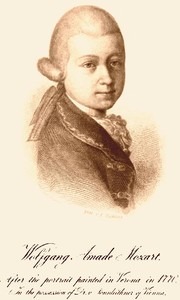
Life of Mozart, Vol. 1 (of 3) by Otto Jahn

(7 User reviews)   6861
By Robert Nguyen Posted on Dec 11, 2025
In Category - Exploration
Jahn, Otto, 1813-1869 Jahn, Otto, 1813-1869
English
Forget the marble busts and powdered wigs. Otto Jahn's biography of Mozart, first published in the 1850s, is like getting a backstage pass to the 18th century. This first volume takes us from the child prodigy dragged across Europe by his ambitious father to the young man struggling to escape that very shadow. The real mystery Jahn explores isn't just how Mozart wrote such perfect music, but how he survived the immense pressure of being a genius from the age of five. It's less about a flawless idol and more about a real person—a son, a employee, and an artist trying to find his own voice against all odds. If you think you know Mozart, this foundational biography will surprise you.
Share

Read "Life of Mozart, Vol. 1 (of 3) by Otto Jahn" Online

This book is available in the public domain. Start reading the digital edition below.

START READING FULL BOOK
Instant Access    Mobile Friendly

Book Preview

A short preview of the book’s content is shown below to give you an idea of its style and themes.

Introduction to the Second Edition Translator's Note......... I.--Childhood......... II.--Early Journeys..... III.--Study in Salzburg...... IV.--The First Opera in Vienna V.--The Italian Tour..... VI.---Works in Germany..... VII.--Opera Sbria........ VIII.--Mozart's Early Operas IX.--Oratorio........ X.--Opera Buffa........ XI.--Mozart's "Re Pastore".. XII.--Sonos ........... XIII.--Church Music........ XIV.--Instrumental Music..... XV.--Early Manhood..... XVI.--Munich and Augsburg XVII.--Mannheim VOLUME I. {PREFACE TO THE ENGLISH EDITION.} I HAVE been asked to say a few words by way of welcome to the translation of Jahn's Life of Mozart, and I do so with pleasure. The book has been long familiar to me, and I regard its appearance in an English dress as an event in our musical history. It will be a great boon to students and lovers of music, and it shows how much the study of music has advanced among us when so large and serious a work is sufficiently appreciated to repay the heavy expense attendant on its translation and publication. The book itself is what the Germans call an "epoch-making work." The old biographies of musicians, such as Forkel's Life of Bach (1802) and Dies's of Haydn (1810), are pleasant gossipy accounts of the outward life of the composers; but they concern themselves mainly with the exterior both of the man and his productions, and there is a sort of tacit understanding throughout that if the reader is a professional musician he will know all about the music, if he is an amateur it is altogether out of his reach. Characteristic traits and anecdotes there are in plenty, but as to how the music was made or came into being, what connection existed between it and the circumstances or surroundings of the composer, what relation it had to that of his predecessors or contemporaries, how far the art was advanced by the labours of this particular composer or player--all that is outside the province of the book. Schindler's Life of Beethoven (Münster, 1840--a much smaller book than it afterwards became) was hardly more {PREFACE.} than this, and in addition is so deformed by want of method and by faults of style as to be very uninviting to the reader. A step in the right direction was taken in Moscheles' English translation (or rather adaptation) of Schindler (1841). Moscheles' residence in London had shown him that there was even then a public outside the professional musician to whom such works would be interesting, and he accordingly took pains, by inserting musical examples and other means, to make his edition attractive to this class. But the inherent defects of the original work prevented more than a moderate success. The first real attempt at a biography of a composer that should interest all classes was the work of an Englishman. Edward Holmes was not only a musician, but a cultivated man with a good literary style, and his Life of Mozart, including his Correspondence (1845), was very nearly all that such a book should be. It was derived from original sources, it was full and yet condensed, it blended admirably the portrait of the man with the portrait of the musician, it contained for that time a considerable amount of musical illustrations, and lists of the works; and in addition to this it was written in a style attractive to the amateur, and even to the ordinary reader. It was largely read, and has long since been out of print.* More than this, it extorted praise from a German writer, and that a German should praise any English work on a musical subject is indeed an event. The terms of warm commendation in which Jahn mentions it in his introduction are in...

This is a limited preview. Download the book to read the full content.

Ever wondered what it was actually like to be Mozart? Otto Jahn's massive biography, the first of its kind, tries to answer that by sifting through letters, concert announcements, and contemporary accounts. This first volume covers from his birth in 1756 up to about 1780, just as he's settling in Vienna.

The Story

We meet Wolfgang as a ridiculously talented little kid, performing for emperors and kings while his father, Leopold, meticulously manages (and profits from) the tour. The book follows this exhausting childhood of constant travel and performance, through his turbulent teenage years trying to find a stable job as a court musician, and into early adulthood. It's a story of incredible artistic growth happening alongside personal frustration—stuck in his hometown of Salzburg, clashing with his employer, the Archbishop, and dreaming of bigger stages.

Why You Should Read It

Jahn's great strength is context. He doesn't just tell us Mozart wrote a symphony; he shows us the world he wrote it in—the politics of royal courts, the fickle tastes of audiences, the sheer grind of being a working musician. You see the man behind the myth: impatient, brilliant, sometimes funny, and often desperate for independence. It makes the music that came later feel earned, a hard-won triumph.

Final Verdict

This is for the curious music lover who wants to go deeper than a playlist or a Wikipedia page. It's perfect for anyone interested in how art gets made, the complex relationships between fathers and sons, or just a brilliantly detailed slice of 18th-century life. Be warned: it's dense and detailed (it was written for 1850s scholars, after all), but the portrait that emerges is utterly human and completely fascinating.


🟢 Public Domain Notice

This book is widely considered to be in the public domain. It serves as a testament to our shared literary heritage.

Ethan Lewis
7 months ago

This is one of those stories where the atmosphere created is totally immersive. I would gladly recommend this title.

Matthew Jackson
1 year ago

I had low expectations initially, however it provides a comprehensive overview perfect for everyone. Truly inspiring.

Kevin Jones
1 year ago

I started reading out of curiosity and the emotional weight of the story is balanced perfectly. This story will stay with me.

Kenneth Jackson
10 months ago

The fonts used are very comfortable for long reading sessions.

Aiden Hernandez
2 years ago

Perfect.

4.5
4.5 out of 5 (7 User reviews )

Add a Review

Your Rating *
There are no comments for this eBook.
You must log in to post a comment.
Log in


Related eBooks