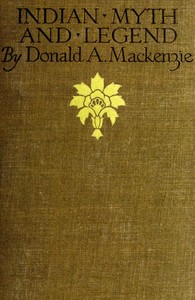
Indian Myth and Legend by Donald A. Mackenzie

(1 User reviews)   3182
By Robert Nguyen Posted on Jan 10, 2026
In Category - Exploration
Mackenzie, Donald A. (Donald Alexander), 1873-1936 Mackenzie, Donald A. (Donald Alexander), 1873-1936
English
Hey, have you ever wanted to understand the grand stories that shaped India's soul? This book is your chance. Forget dusty, academic tomes. 'Indian Myth and Legend' is like a grand tour through a living, breathing world of gods, demons, and heroes. It’s not just about the famous epics like the Mahabharata and Ramayana, though they're here in all their glory. It’s about the cosmic battles between order and chaos, the impossible choices heroes face, and the deep questions about duty and destiny that feel surprisingly relevant today. Mackenzie gathers these ancient tales into one compelling volume, showing how they’re not just stories, but the foundation of a culture. If you're curious about where so much of India's art, philosophy, and even modern pop culture draws its power from, start here.
Share

Read "Indian Myth and Legend by Donald A. Mackenzie" Online

This book is available in the public domain. Start reading the digital edition below.

START READING FULL BOOK
Instant Access    Mobile Friendly

Book Preview

A short preview of the book’s content is shown below to give you an idea of its style and themes.

and above all their conceptions of God, the soul, and the Universe. Some knowledge of them is necessary for those who desire to approach with sympathy the investigation of the religious beliefs of our Hindu fellow men and to understand their outlook upon life and the world. The Introduction deals with various aspects of the study of these ancient myths and legends which have been the inspiration of a national literature infused with much grandeur and sublimity. The historic Aryan controversy, of which the science of comparative mythology is a by-product, is passed under review, and it is shown to what extent philological theories regarding race problems have been modified during recent years as a result of the adoption of broader and more exact methods of ethnic and archæological research and the ever-extending study of comparative mythology. There has also been condensed much important data dealing with the early phases of Aryo-Indian civilization accumulated for historical purposes by industrious and painstaking Sanskrit scholars who have been engaged in investigating and systematizing the internal evidence of the various religious poems and treatises. It will be found that no general agreement has yet been reached regarding Aryo-Indian chronology, but it now appears to be well established that although there were early cultural as well as racial “drifts”, fresh invasions, which had far-reaching results in the social and religious life of northern India, occurred at a late period in what is known as the Vedic Age. In consequence, the problem presented by this ancient civilization tends rather to grow more complex than to become simplified. Its origin is still wrapped in obscurity. At the very dawn of history Aryo-Indian culture had attained a comparatively high state of development, and a considerable period must be allowed for its growth. Even some of the ancient Vedic hymns, addressed by priests to the deities, are styled “new songs”, which suggests the existence of an older collection. Many of them also afford indications that immemorial beliefs were in process of change and fusion. The sublime deities, Varuna and Mitra (Mithra), for instance, were already declining in splendour. Yet they must have been closely associated with Indra, king of the gods, in the unknown Aryan homeland, as is made evident by an inscription recently deciphered at Boghaz Köi, in Asia Minor, which refers to them as deities of the mysterious Mitanni people who were of Aryan speech like the settlers in the Punjab. There is no evidence, however, that the Mitanni rulers gave recognition to the fire god Agni, who in India was exalted as the twin brother of Indra. The problem involved may not be devoid of ethnic significance, although the identity of the Agni-worshipping section of the early raiders remains obscure. During the early Vedic Age in India prominence was given to the gods: the social organization was of patriarchal character; the goddesses remained shadowy and vague, some being, indeed, little more than figures of speech. A great change took place, however, after the invasions of the Bharata and other tribes who are now referred to as “late comers”. Profound and speculative thinkers attained to the pantheistic conception of the world soul; new doctrines, which are not referred to in the Vedic hymns, regarding the ages of the universe and transmigration of souls, received wide acceptance as the result of missionary efforts: the Vedic gods were reduced to the position of minor deities and new goddesses rose into prominence, one indeed being Bharati, the tribal deity of the Bharatas, who became associated with the Saraswati river and under her new name was ultimately made the wife...

This is a limited preview. Download the book to read the full content.

So, what's this book actually about? It's not a novel with a single plot. Think of it as a guided collection. Donald A. Mackenzie, writing in the early 1900s, acts as your curator, pulling together the major myths and legends from ancient Indian texts like the Vedas, the Puranas, and the two great epics. He starts from the very beginning—the creation of the universe—and walks you through the ages of the gods, the rise of great heroes like Rama and Krishna, and the earth-shattering war of the Mahabharata.

Why You Should Read It

Here's the thing: these stories are incredibly human. Yes, there are gods wielding divine weapons, but at their heart, they're about family rivalry, impossible promises, moral gray areas, and the search for truth. The conflict in the Mahabharata, for instance, isn't just good vs. evil; it's about what you do when your duty to your family clashes with your duty to justice. Mackenzie presents these epic conflicts with a clarity that lets their timeless power shine through. You get a real sense of the scale and depth of this mythological world.

Final Verdict

This is the perfect book for anyone with a budding interest in world mythology who doesn't know where to start with India's vast traditions. It's also great for fiction lovers looking for the original source material that inspires so many books and shows today. It’s a foundational text, a bit old-fashioned in its language but never dry. If you want to understand the stories that have captivated millions for millennia, this is your welcoming and comprehensive starting point.


🔓 Public Domain Content

This work has been identified as being free of known copyright restrictions. It serves as a testament to our shared literary heritage.

Steven Young
1 month ago

I didn't expect much, but the author's voice is distinct and makes complex topics easy to digest. One of the best books I've read this year.

5
5 out of 5 (1 User reviews )

Add a Review

Your Rating *
There are no comments for this eBook.
You must log in to post a comment.
Log in


Related eBooks