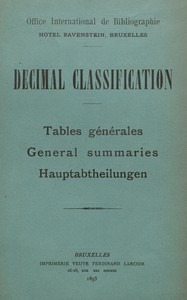
Decimal Classification. Tables générales by International Institute of Bibliography

(7 User reviews)   4202
By Robert Nguyen Posted on Dec 30, 2025
In Category - Exploration
International Institute of Bibliography International Institute of Bibliography
French
Ever wonder how libraries organize all those books? This isn't a novel—it's the rulebook. Imagine the chaos of a world without a system for finding information. The 'Decimal Classification' tables are the secret blueprint librarians have used for over a century to bring order to the chaos of human knowledge. It's the story of how we decided where every single fact, idea, and story belongs on a shelf. Sounds dry? It's actually the quiet, foundational drama behind every library you've ever walked into. It's the hidden architecture of the thinking world.
Share

Read "Decimal Classification. Tables générales by International Institute of Bibliography" Online

This book is available in the public domain. Start reading the digital edition below.

START READING FULL BOOK
Instant Access    Mobile Friendly

Book Preview

A short preview of the book’s content is shown below to give you an idea of its style and themes.

Produced by Susan Skinner and the Online Distributed Proofreading Team at http://www.pgdp.net (This file was produced from images generously made available by the Mundaneum and mediated by the artists of Algolit, a research project initiated by Constant.) Office International de Bibliographie HOTEL RAVENSTEIN, BRUXELLES * * * * * DECIMAL CLASSIFICATION Tables générales General summaries Hauptabtheilungen * * * * * _BRUXELLES_ IMPRIMERIE VEUVE FERDINAND LARCIER 26-28, RUE DES MINIMES 1895 PREMIÈRE TABLE CLASSES 0. OUVRAGES GÉNÉRAUX 1. PHILOSOPHIE 2. RELIGION 3. SOCIOLOGIE 4. PHILOLOGIE 5. SCIENCES 6. SCIENCES APPLIQUÉES 7. BEAUX-ARTS 8. LITTÉRATURE 9. HISTOIRE SECONDE TABLE DIVISIONS 000 Ouvrages généraux. 010 Bibliographie. 020 Bibliothéconomie. 030 Encyclopédies générales. 040 Collections générales. 050 Périodiques généraux. 060 Sociétés générales. 070 Journaux. 080 Bibliot. spéciales. Polygraphie. 090 Livres rares. 100 Philosophie. 110 Métaphysique. 120 Sujets spéciaux de métaphysique. 130 L’esprit et le corps. 140 Systèmes philosophiques. 150 Facultés mentales. Psycholog. 160 Logique. 170 Ethique. 180 Philosophes anciens. 190 Philosophes modernes. 200 Religion. 210 Théologie naturelle. 220 Bible. 230 Théol. doctrinale. Dogmatique. 240 Dévotion. Pratique. Œuvres. 250 Sermons. Clergé. Paroisse. 260 L’Église: ses institutions. 270 Histoire religieuse. 280 Religions et sectes chrétiennes. 290 Religions non chrétiennes. 300 Sociologie. 310 Statistique. 320 Science politique. 330 Économie politique et sociale. 340 Droit. 350 Administration. 360 Assistance. Assurance. 370 Enseignement. 380 Commerce. Transport. 390 Coutumes. Costumes. Folklore. 400 Philologie. 410 Comparée. 420 Anglaise. 430 Germanique. 440 Française. 450 Italienne. 460 Espagnole. 470 Latine. 480 Grecque. 490 Langues secondaires. 500 Sciences. 510 Mathématiques. 520 Astronomie. 530 Physique. 540 Chimie. 550 Géologie. 560 Paléontologie. 570 Biologie. 580 Botanique. 590 Zoologie. 600 Sciences appliquées. 610 Médecine. 620 Art de l’ingénieur. 630 Agriculture. 640 Economie domestique. 650 Transport. Commerce. 660 Chimie appliquée. 670 Manufactures. 680 Industrie mécanique. 690 Construction. 700 Beaux Arts. 710 Paysages de jardins. 720 Architecture. 730 Sculpture. 740 Dessin. Décoration. 750 Peinture. 760 Gravure. 770 Photographie. 780 Musique. 790 Récréations. 800 Littérature. 810 Américaine. 820 Anglaise. 830 Germanique. 840 Française. 850 Italienne. 860 Espagnole. 870 Latine. 880 Grecque. 890 Littératures secondaires. 900 Histoire. 910 Géographie. 920 Biographie. 930 Histoire ancienne. 940 { Europe. 950 { Asie. 960 { Afrique. 970 Hist. Mod. { Amérique du Nord. 980 { Amérique du Sud. 990 { Océanie. Régions polaires. TROISIÈME TABLE SUBDIVISIONS OUVRAGES GÉNÉRAUX 000 001 } 002 } 003 } 004 } Laissé en blanc pour usages particuliers. 005 } 006 } 007 } 008 } 009 } 010 Bibliographie. 011 Bibliogr. générales. 012 » spéciales d’auteurs. 013 » par classes d’auteurs. 014 » d’anon. et de pseudon. 015 » par pays. 016 » de sujets spéciaux. 017 Catalogues par ord. de matières. 018 » par nom d’auteur. 019 » par ordre alphabét. 020 Bibliothéconomie. 021 But des bibliothèques. 022 Constructions et aménagements. 023 Administration et personnel. 024 Règlements pour les lecteurs. 025 Organisation des bibliothèques. 026 Biblioth. de matières spéciales. 027 » générales. 028 Lecture: assistance aux lecteurs. 029 L’art d’étudier. 030 Encyclopédies générales. 031 Américaines. 032 Anglaises. 033 Allemandes. 034 Françaises. 035 Italiennes 036 Espagnoles. 037 Slaves. 038 Scandinaves. 039 Langues secondaires. 040 Collect. gén. de manuels. 041 Américains. 042 Anglais. 043 Allemands. 044 Français. 045 Italiens. 046 Espagnols. 047 Slaves. 048 Scandinaves. 049 Langues secondaires. 050 Périodiques généraux. 051 Américains. 052 Anglais. 053 Allemands. 054 Français. 055 Italiens. 056 Espagnols. 057 Slaves. 058 Scandinaves. 059 Langues secondaires. 060 Sociétés générales. 061 Américaines. 062 Anglaises. 063 Allemandes. 064 Françaises. 065 Italiennes. 066 Espagnoles. 067 Slaves. 068 Scandinaves. 069 Langues secondaires. 070 Journaux. 071 Américains. 072 Anglais. 073 Allemands. 074 Français. 075 Italiens. 076 Espagnols. 077 Slaves. 078 Scandinaves. 079 Langues secondaires. 080 Bibl. spéc. Polygraphies. 081 }...

This is a limited preview. Download the book to read the full content.

This book is not about characters or plot twists. Instead, it presents a system—the Dewey Decimal System. It's a massive set of tables that assigns a number to every conceivable subject, from philosophy (100s) to history (900s) and everything in between. The 'story' is the creation of a universal language for organizing books, so that a volume on Greek myths or butterfly anatomy can be found in the same place in a library in Paris or Peoria.

Why You Should Read It

If you love libraries, this is like seeing the engine under the hood. It’s fascinating to flip through and see how human knowledge was categorized in the early 20th century. You get a real sense of the ambition to tame the information explosion of its time. It’s a snapshot of how we once saw the entire universe of ideas, neatly divided and numbered. Reading it feels like you’ve been given a master key to the library of the world.

Final Verdict

This is a niche pick, but a perfect one for curious minds who love books as objects and systems. It's for library science students, history nerds fascinated by how things work, or anyone who’s ever stared at the spines in a library and wondered, 'Why is this here?' It’s not a page-turner in the traditional sense, but it’s a deeply satisfying piece of intellectual history you can dip into anytime.


📚 Copyright Status

This content is free to share and distribute. Use this text in your own projects freely.

Noah Wilson
1 year ago

Very helpful, thanks.

Susan Walker
2 months ago

Not bad at all.

Donald Perez
9 months ago

Finally a version with clear text and no errors.

Ava Moore
1 year ago

I came across this while browsing and it provides a comprehensive overview perfect for everyone. A true masterpiece.

Kevin Martin
7 months ago

Very helpful, thanks.

5
5 out of 5 (7 User reviews )

Add a Review

Your Rating *
There are no comments for this eBook.
You must log in to post a comment.
Log in


Related eBooks