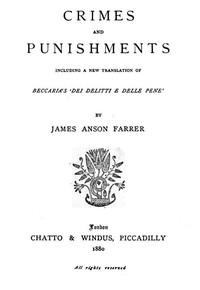
Crimes and Punishments by James Anson Farrer

(2 User reviews)   2588
By Robert Nguyen Posted on Jan 10, 2026
In Category - Geography
Farrer, James Anson, 1849-1925 Farrer, James Anson, 1849-1925
English
Imagine a book that's less about solving a crime and more about understanding why we punish people in the first place. That's 'Crimes and Punishments' by James Anson Farrer. Forget a single whodunit; this is a fascinating journey through history, looking at how societies from ancient Rome to Victorian England decided what was a crime and what gruesome, strange, or surprisingly lenient penalty fit it. It’s a thought-provoking read that makes you question the very foundations of justice we often take for granted. If you've ever wondered why we do the things we do to people who break the rules, this book has some surprising answers.
Share

Read "Crimes and Punishments by James Anson Farrer" Online

This book is available in the public domain. Start reading the digital edition below.

START READING FULL BOOK
Instant Access    Mobile Friendly

Book Preview

A short preview of the book’s content is shown below to give you an idea of its style and themes.

sentence in the book on which a commentator might not be prolix. To combine the maximum of perspicuity with the maximum of fidelity to the original has been the cardinal principle observed in the translation. But it would, of course, have been no less impossible than contrary to the spirit of the original to have attempted to render perfectly comprehensible what the author purposely wrapped in obscurity. A translation can but follow the lights and shades of the surface it reflects, rendering clear what is clear in the original, and opaque what is opaque. _CONTENTS._ PAGE CHAPTER I. BECCARIA’S LIFE AND CHARACTER. State of Lombardy under Count Firmian—The state of criminal law—Torture still in use—The abolition of torture before Beccaria—Beccaria not a lawyer by profession—Autobiographical letter of Beccaria to the Abbé Morellet—Influence on Beccaria of Montesquieu and Helvetius—His philosophy of life and truth—His friends, the Verri—Connection with Pietro Verri—The Caffé periodical—Reception of the ‘Dei Delitti’ in Paris—Translation of it by Morellet—Commentary by Voltaire—The Swiss medal—Beccaria’s fear of ecclesiastical persecution a motive for occasional obscurity—Feeling in Venice against the author—Facchinei’s criticism—Protection of Count Firmian—Adverse criticism by contemporary lawyers—Ramsay’s letter to Diderot, illustrative of the despair of reform—Beccaria’s journey to Paris—His speedy return—Enmity and jealousy of Pietro Verri—Beccaria’s invitation to St. Petersburg—His lectures on political economy, and later life 1 CHAPTER II. THE GENERAL INFLUENCE OF BECCARIA ON LEGISLATION. Present inconceivability of torture due to Beccaria—How far he was the first to write against it—Torture first abolished in England—Beccaria’s influence in Russia—Quotations from his treatise in Catharine’s instruction for the new code—Beccaria’s influence in France; Tuscany; Austria; Pennsylvania—Beccaria the first advocate of the abolition of capital punishment—Relative severity of death and other penalties—Slight relation of crime to punishment—Reasons why capital punishment is always more uncertain than other penalties—Cases accounting for its uncertainty—The efficiency of a punishment its real test—Futility of discussing the general right of punishment—Instances of the abolition of capital punishment in ancient and modern times—The argument for its abolition the same as that for the abolition of torture 29 CHAPTER III. THE INFLUENCE OF BECCARIA IN ENGLAND. General debt of English law to Beccaria—English utilitarianism due to Beccaria—His influence first traceable in Blackstone—Fallacy of old criminal law in making the amount of temptation the measure of punishment—Eden the first to expose it in his ‘Principles of Penal Law’—Attitude of men of letters to the criminal law, as of Goldsmith, Lord Kames, and Fielding—First attempt at law reform by Sir W. Meredith—Constant opposition of the House of Lords—Effect on reform of Madan’s ‘Executive Justice’ and Paley’s chapter on Crimes and Punishments—Relation of Paley to Lord Chief Justice Ellenborough—Paley’s defence of English law—His approval of the suggestion of throwing murderers into a den of wild beasts—Howard’s ideas of reform and contribution to it—Bad effect of the French Revolution in England—Romilly’s original idea of reform—His Privately Stealing Bill—His criticism of Paley—His Shoplifting Bill rejected by the Lords—The pillory defended by Lord Ellenborough—Capital punishment for forgery by Lord Tenterden—Rapid changes after the Reform Bill—The triumph of Beccaria’s principles 46 CHAPTER IV. THE PROBLEMS OF PENOLOGY. The spirit of Beccaria’s work—The slow progress of penology as a science—Its difficulties—Confusion of guilty and innocent—Relation of intention to crime—Objects and animals once part of the criminal world—Penal laws the expression of moral sentiments, and also the cause of them—Tendency of actions to remain immoral when they have ceased to be penal—Illustration from suicide and infanticide—The Equality of punishment, its Analogy and Proportion to crime, as principles of penal law—The object of punishment—The difficulties of the deterrent-and-reformative theory—The object of law to regulate natural vindictiveness—Traceable historically to this...

This is a limited preview. Download the book to read the full content.

This isn't your typical crime story. James Anson Farrer's book is a historical tour of justice systems, from the ancient world to the 19th century. Instead of following a detective, we follow ideas. Farrer examines the laws of societies like Babylon, Greece, and Rome, and then traces how those ideas evolved through medieval Europe and into his own Victorian era. He shows us the punishments—some brutal, some bizarre—that were considered normal, and asks the big question: what were these societies trying to achieve? Was it revenge, deterrence, or something else entirely?

Why You Should Read It

This book completely changed how I think about the law. It's easy to assume our modern justice system is the logical endpoint of progress. Farrer shows it's messier than that, full of contradictions and experiments. The real strength is how he connects old laws to human nature. You see the same fears, the same desire for order, and the same capacity for cruelty playing out across centuries. It’s less a dry history lesson and more a mirror held up to our own ideas about right and wrong.

Final Verdict

Perfect for history buffs, true crime fans looking for deeper context, or anyone who enjoys big, philosophical questions wrapped in real-world stories. If you like books that make you stop and think, 'Wait, why *do* we do it that way?' this is for you. It's a compelling, sometimes unsettling, but always insightful look at the long and winding road to modern justice.


📢 Free to Use

This text is dedicated to the public domain. You are welcome to share this with anyone.

Richard Hernandez
1 year ago

Based on the summary, I decided to read it and the atmosphere created is totally immersive. A true masterpiece.

Mark Williams
6 months ago

Clear and concise.

4
4 out of 5 (2 User reviews )

Add a Review

Your Rating *
There are no comments for this eBook.
You must log in to post a comment.
Log in


Related eBooks