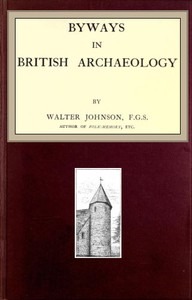
Byways in British Archaeology by Walter Johnson

(11 User reviews)   4911
By Robert Nguyen Posted on Dec 11, 2025
In Category - Geography
Johnson, Walter, 1867- Johnson, Walter, 1867-
English
Ever wondered why a village is shaped like that, or what those odd lumps in a field really are? Walter Johnson's 'Byways in British Archaeology' is like having a brilliant, slightly dusty professor as your personal guide. Forget grand cathedrals and royal palaces for a moment. This book is about the quiet history under our feet—the forgotten footpaths, the meaning behind old field names, and the stories that local landscapes whisper if you know how to listen. It’s not about finding treasure; it’s about learning to see the ordinary world as profoundly strange and ancient. If you've ever gone for a walk in the British countryside and felt a curious tug of the past, this book will give you the eyes to see it.
Share

Read "Byways in British Archaeology by Walter Johnson" Online

This book is available in the public domain. Start reading the digital edition below.

START READING FULL BOOK
Instant Access    Mobile Friendly

Book Preview

A short preview of the book’s content is shown below to give you an idea of its style and themes.

of disconnected essays, really possess a strong bond of continuity. Running through the whole, implied, where not actually expressed, will be found an insistence on the principle which, in a former work, I ventured to call folk-memory. This folk-memory--unconsciously, for the most part, but sometimes with open ceremony--keeps alive those popular beliefs and practices which are individually called survivals. With some of these legacies from the past the present volume deals. To a large extent the studies are connected with the church and churchyard. The sections which treat of pagan sites, orientation, and burial customs, embody the results of observations relating to some hundreds of buildings in all parts of England and Wales. The chapters on “The Folk-Lore of the Cardinal Points” and “The Labour’d Ox” partially, at least, break virgin soil. In “The Churchyard Yew” are set down inferences drawn from many years of investigation, the literary side of which has been rendered difficult by the existence, in various modern works, of unfounded statements and hypothetical references. The remainder of the book treats of somewhat more familiar themes, though it is hoped that fresh outlooks are suggested. Since some of the matters here brought forward have been, and indeed still are, provocative of keen, and even heated controversy, to anticipate agreement with all the conclusions would be sheer folly. Nevertheless, it may be claimed that the facts collected have been carefully sifted, the references conscientiously verified, and the opposing theories honestly presented. To the multitude of friends who have rendered true service either by supplying information or in preparing the illustrations, most grateful thanks are expressed. Acknowledgements of all such help are recorded in due place, but special recognition must be made of the expert assistance of Mr Sydney Harrowing, who has borne the chief burden in illustrating the volume. To Miss Nora Mansell thanks are tendered for the drawing of Gumfreston church (Fig. 26). Fig. 93 is copied from a sketch prepared by Mr C. G. Carter, of Louth. Messrs Frank Cowley and F. J. Bennett, F.G.S., have kindly permitted the reproduction of an original painting (Fig. 87). Mr Worthington G. Smith, F.L.S., has courteously allowed Figs. 59 and 60 to be taken from _Man, the Primeval Savage_; Fig. 80 is copied by the consent of Professor R. S. Lull; and Figs. 4, 22 and 88 appear by the kindness of Mr David Sydenham, the Rev. Percival Saben, M.A., and the British Archaeological Association respectively. Dr W. Heneage Legge and Messrs G. Allen and Sons have granted the use of the block for Fig. 92, while Figs. 84 and 85 were photographed from a horseshoe lent by the Rev. Hastings M. Neville, B.A., of Ford, Northumberland. Many of the photographs were taken by Mr Edward Yates, who allowed free choice to be made from his large collection, but the following ladies and gentlemen have also assisted: Mr O. F. Bailey, Mr Alexander Barbour, Mr J. G. V. Dawson, Mr E. W. Filkins, Miss Truda Hutchinson, Mrs W. Johnson, Mr A. L. Leach, F.G.S., Mr Douglas Leighton, Mr P. McIntyre, F.G.S., Mr Llewellyn Treacher, F.G.S., Mr W. C. Walker, Mr E. C. Youens, Mr G. W. Young, F.G.S., F.Z.S., and Mr W. Plomer Young. Permission to use photographs has also been granted by Mr James Cheetham of Lewes, Messrs Thos. B. Latchmore and Son, Hitchin, Mr W. Wiseman, Corfe Castle, the _Grimsby Telegraph_ Company, and the Watford Engraving Company. W. J. _January, 1912_ CONTENTS PAGE I. CHURCHES ON PAGAN SITES 1 II. CHURCHES ON PAGAN SITES (_continued_) 51 III. THE SECULAR USES OF THE CHURCH FABRIC 101 IV. THE...

This is a limited preview. Download the book to read the full content.

Forget dry academic lists of pottery shards. Walter Johnson’s book isn't a report from a dig site; it's an invitation to look at the world differently. He argues that true archaeology isn't just in museum cases, but in the living landscape around us.

The Story

There isn't a single narrative, but a journey through the overlooked corners of Britain. Johnson takes us down ancient trackways that determined where villages grew. He deciphers the clues hidden in place names, showing how words like "ley" or "worth" map forgotten settlements. He examines everyday things—the shape of a village green, the layout of a field system, the purpose of a dew pond—and connects them to centuries of human life and work. The plot, in a sense, is the detective work of piecing together history from what most people simply walk past.

Why You Should Read It

This book is a quiet revelation. It gives you a superpower: the ability to read a landscape. After reading it, a simple walk becomes an exploration. You start noticing why a road curves oddly (following an old boundary) or what a cluster of certain trees might mean (marking a lost homestead). Johnson’s passion is contagious. He treats these 'byways' not as minor footnotes, but as the main story of how ordinary people lived, worked, and shaped their world.

Final Verdict

Perfect for curious walkers, local history enthusiasts, or anyone who feels there's more to the countryside than just pretty views. It’s not a fast-paced thriller, but a slow, rewarding companion that makes your surroundings infinitely more interesting. If you enjoy the work of later writers like W.G. Hoskins or the vibe of 'Time Team,' you'll find the roots of that landscape-loving spirit right here.


🏛️ Copyright Free

This digital edition is based on a public domain text. You are welcome to share this with anyone.

Emily Harris
10 months ago

Surprisingly enough, the pacing is just right, keeping you engaged. I would gladly recommend this title.

Melissa Wright
1 year ago

After hearing about this author multiple times, the plot twists are genuinely surprising. I learned so much from this.

Noah Scott
1 year ago

Very helpful, thanks.

Paul Allen
1 month ago

Having read this twice, the clarity of the writing makes this accessible. I will read more from this author.

Patricia Lewis
1 year ago

I came across this while browsing and the author's voice is distinct and makes complex topics easy to digest. Exceeded all my expectations.


5
5 out of 5 (11 User reviews )

Add a Review

Your Rating *
There are no comments for this eBook.
You must log in to post a comment.
Log in


Related eBooks