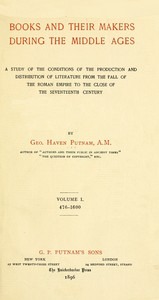
Books and their makers during the Middle Ages : A study of the conditions of…

(4 User reviews)   3959
By Robert Nguyen Posted on Dec 30, 2025
In Category - Exploration
Putnam, George Haven, 1844-1930 Putnam, George Haven, 1844-1930
English
Ever wonder how books survived the Middle Ages? Forget knights and castles—the real heroes were the scribes, monks, and early publishers who fought to keep knowledge alive. George Haven Putnam's book pulls back the curtain on a world where every single book was handmade. It's not just about what people wrote, but the incredible human effort behind each page. You'll discover how books traveled, who could afford them, and why copying a text was a political act. If you love books, this is the origin story you never knew you needed.
Share

Read "Books and their makers during the Middle Ages : A study of the conditions of…" Online

This book is available in the public domain. Start reading the digital edition below.

START READING FULL BOOK
Instant Access    Mobile Friendly

Book Preview

A short preview of the book’s content is shown below to give you an idea of its style and themes.

given to later generations by means of the written or the printed word. A systematised method of book-production we find first in Alexandria, where it had been developed, if not originally instituted, by the intelligent and all-powerful interest of the Ptolemaic kings, but there appears to be no evidence that, even in Alexandria, which for the greater part of two centuries was the great book-producing mart of the world, was there any practice of compensation for authors. It is to be borne in mind, however, in this connection, that, with hardly an exception, the manuscripts produced in Alexandria were copies of books accepted as classics, the works of writers long since dead. For the editors of what might be called the Alexandrian editions of Greek classics, compensation was provided in the form of _honoraria_ from the treasury of the Museum library or of salaried positions in the Museum Academy. In Rome, during the Augustan period, we find record of a well organised body of publishers utilising connections with Athens, with Asia Minor, and with Alexandria, for the purpose of importing Greek manuscripts and of collecting trained Greek scribes, and carrying on an active trade in the distribution of books not only with the neighbouring cities of Italy, of Spain, and of Gaul, but with such far off corners of the empire as the Roman towns in Britain. There are not a few references in the literature of this period, and particularly in the productions of society writers like Martial and Horace, to the relations of authors with their publishers and to the business interests retained by authors in the sale of their books. This Augustan age presents, in fact, the first example in the history of publishing, of a body of literature, produced by contemporary writers, being manifolded and distributed under an effective publishing and bookselling machinery, so as to reach an extensive and widely separated reading public. When the Roman gentleman in his villa near Massilia (in Gaul), Colonia (on the Rhine), or Eboracum (in far off Britain), is able to order through the imperial post copies of the latest ode of Horace or satire of Martial, we have the beginnings of an effective publishing organisation. It is at this time also that we first find record of the names of noteworthy publishers, the bookmakers in Athens and in Alexandria having left their names unrecorded. It is the period of Atticus, of Tryphon, and of the Sosii. Concerning the matter of the arrangements with the authors, or the extent of any compensation secured by them, the information is at best but scanty and often confusing. It seems evident, however, that, apart from the aid afforded by imperial favour, by the interest of some provincial ruler of literary tendencies, or by the bounty of a wealthy private patron like Mæcenas, the rewards of literary producers were both scanty and precarious. With the downfall of the Roman Empire, the organised book-trade of Rome and of the great cities of the Roman provinces came to an end. This trade had of necessity been dependent upon an effective system of communication and of transportation, a system which required for its maintenance the well built and thoroughly guarded roads of the empire; while it also called for the existence of a wealthy and cultivated leisure class, a class which during the periods of civil war and of barbaric invasions rapidly disappeared. Long before the reign of the last of the Roman emperors, original literary production had in great part ceased and the trade in the books of an earlier period had been materially curtailed;...

This is a limited preview. Download the book to read the full content.

The Story

This isn't a story with one main character. Instead, it follows the life of the book itself from the 5th to the 15th century. Putnam starts in the quiet scriptoriums of monasteries, where monks spent years copying texts by candlelight. He then shows how book-making moved into bustling university towns and eventually to the workshops of early printers. The plot, so to speak, is the struggle of ideas against decay, censorship, and sheer physical hardship. It's about how a book went from a rare treasure locked in a chest to something a merchant might own.

Why You Should Read It

It completely changed how I look at my own bookshelf. Putnam makes you feel the weight of history in your hands. You realize that every decision—from the quality of the parchment to the style of the script—tells a story about the society that made it. I was fascinated by the practical details: how ink was made, how traveling scribes worked, and how the rise of universities created a hungry new market for textbooks. It turns the 'Dark Ages' into a period buzzing with intellectual hustle.

Final Verdict

Perfect for history buffs who enjoy deep dives into everyday life, or for any serious book lover with a curiosity about where their passion came from. It's detailed but never dry. While it was written over a century ago, its core ideas feel fresh and surprisingly relevant in our own age of information revolution. Just be ready to see every old book you encounter as a minor miracle.


📜 Free to Use

This book is widely considered to be in the public domain. Thank you for supporting open literature.

Robert Wilson
1 year ago

I had low expectations initially, however the flow of the text seems very fluid. One of the best books I've read this year.

Paul Torres
1 year ago

Perfect.

James Smith
5 months ago

Text is crisp, making it easy to focus.

George Ramirez
2 years ago

As someone who reads a lot, the pacing is just right, keeping you engaged. Exactly what I needed.

4.5
4.5 out of 5 (4 User reviews )

Add a Review

Your Rating *
There are no comments for this eBook.
You must log in to post a comment.
Log in


Related eBooks